Cosmic Lighthouses: Using Starlight to Spot Supermassive Black Hole Pairs
What if the universe's most elusive objects - pairs of supermassive black holes spiraling toward collision - could be found not by detecting their gravitational waves, but by watching them magnify distant starlight a million times over?
Listen to This Article
AI-generated discussion • ~8 min
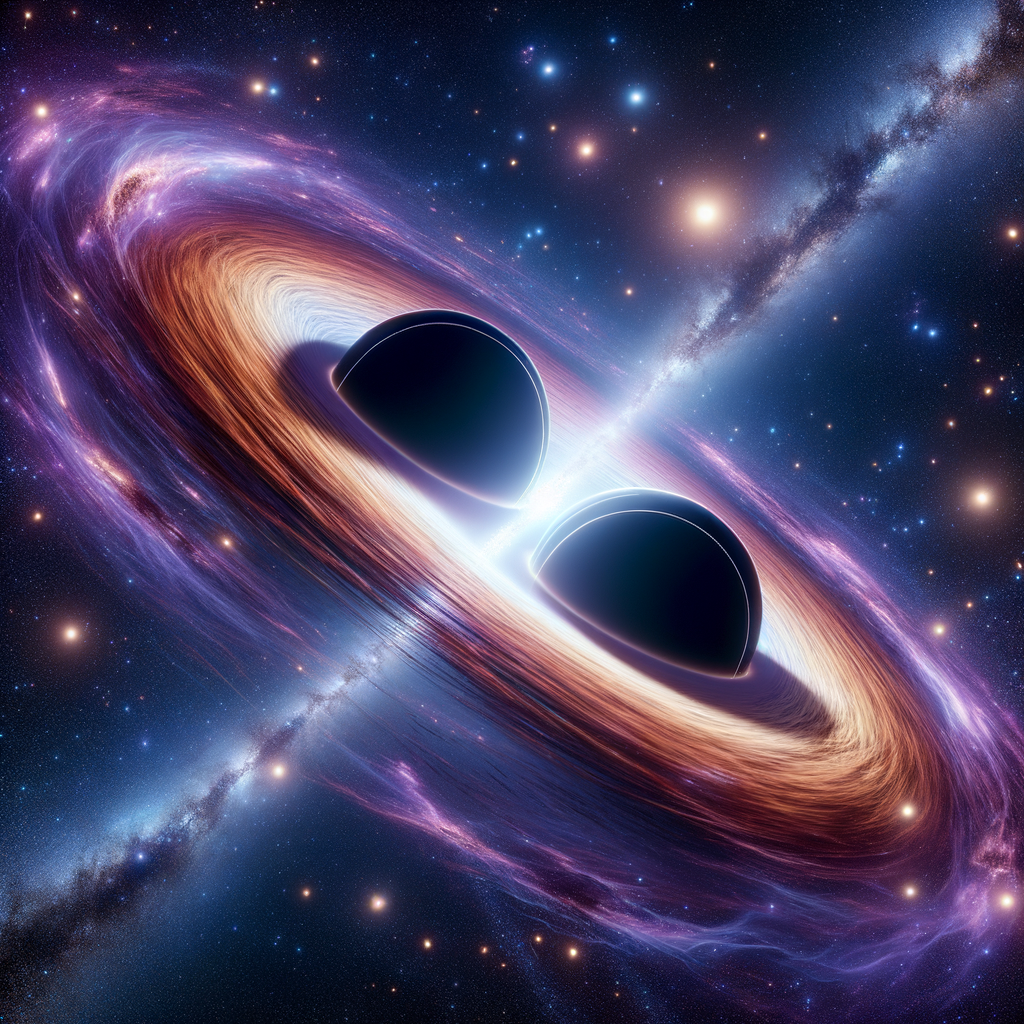
Every time two galaxies merge -and they merge frequently over cosmic time -their central supermassive black holes begin a slow, inevitable dance toward each other. These binary black hole systems should be common throughout the universe, yet confirming their existence at close separations has proven maddeningly difficult. Now, physicists at Oxford and the Max Planck Institute have proposed an elegant solution: let the black holes themselves act as telescopes.
The idea exploits gravitational lensing -the warping of light by massive objects that Einstein predicted a century ago. A single black hole bends light from background stars. But a pair of orbiting black holes creates something far more dramatic: a rotating network of caustics -mathematical curves where light magnification skyrockets to extraordinary levels.
As the binary orbits, these caustic curves rotate rigidly, sweeping across the field of background stars like a cosmic lighthouse beam. When an individual bright star -say, a massive O-type star -crosses one of these caustics, it is magnified by factors of 10,000 to 1,000,000. The result is a distinctive, repeating pattern of brightness spikes that the researchers call QPLS -Quasi-Periodic Lensed Starlight.
The beauty of QPLS is that the timing, spacing, and shape of these brightness peaks encode precise information about the binary. A circular binary produces 8 brightness peaks per orbit. An eccentric binary produces roughly one peak near each apocenter passage, with distinctive double-peaked structures. By analyzing the lightcurve -much like gravitational wave astronomers analyze their waveforms -researchers can extract the binary's masses, orbital period, separation, eccentricity, and inclination.
The researchers modeled specific example systems to demonstrate feasibility. One system -a binary with combined mass of 20 billion solar masses and a one-year orbital period -produces lensing spikes every two months, with maximum magnification reaching 1.8 million at 3.8 years before merger. The QPLS signal would be visible for the final 13 years of the binary's life, providing an electromagnetic early warning system for an upcoming gravitational wave event.
This multi-messenger aspect is particularly exciting. The LISA space observatory, planned for launch in the 2030s, will detect gravitational waves from merging supermassive black holes. But knowing where to look dramatically improves sensitivity. QPLS detections could provide position information years to decades before LISA observes the merger, enabling precisely targeted follow-up observations.
Population models suggest between 1 and 50 detectable QPLS binaries with periods under 10 years exist within redshift z < 0.3 (roughly 4 billion light-years). When accounting for stellar density variations, this could scale to thousands. The total rate of caustic crossings across all detectable binaries reaches 300 to 100,000 events per year.
The technique is perfectly suited for upcoming astronomical surveys. The Vera C. Rubin Observatory will monitor roughly 20 billion galaxies over 10 years with its Legacy Survey of Space and Time. The Nancy Grace Roman Space Telescope will provide complementary deep observations. Together, they could turn the night sky into a vast detector array for binary supermassive black holes.
As co-author Miguel Zumalacarregui puts it: "Supermassive black holes act as natural telescopes." In one of science's most elegant inversions, the very objects we are trying to find become the instruments that reveal themselves -focusing starlight into beacons visible across the cosmos.
Real-World Impact
Quick Takeaways
- Proposes a new electromagnetic method to detect supermassive black hole binaries that have eluded confirmation at close separations
- Binary black holes magnify individual background stars by factors of 10,000-1,000,000 through rotating gravitational caustics, creating detectable periodic brightness signals
- Could provide years-to-decades advance warning of black hole mergers before gravitational wave observatories like LISA detect them
- Population models predict 300-100,000 caustic crossing events per year detectable with upcoming surveys like the Vera C. Rubin Observatory
The detection of close supermassive black hole binaries represents one of the most important unsolved problems in astrophysics. While galaxy mergers are ubiquitous and should inevitably produce binary systems, confirming their existence at sub-parsec separations has remained beyond current observational capabilities. QPLS offers the first viable electromagnetic detection method for these systems in non-active galaxies -galaxies without the bright accretion disks that make active galactic nuclei conspicuous. This opens an entirely new population of binary systems to study, potentially revealing how galaxies evolve through mergers and how their central black holes grow.
The multi-messenger astronomy implications are profound. LISA's gravitational wave sensitivity depends on knowing where to look in the sky, and QPLS could provide precisely that information years before merger. This advance warning capability would enable coordinated observations across the electromagnetic spectrum, from radio to X-ray, creating the most comprehensive view of a supermassive black hole merger ever achieved. Such observations would test general relativity in the strong-field regime, constrain models of black hole accretion and jet formation, and potentially reveal new physics.
From a practical standpoint, the technique requires no new technology -only data from surveys already planned or underway. The Vera C. Rubin Observatory's LSST, the Nancy Grace Roman Space Telescope, and even current facilities like the Zwicky Transient Facility could potentially identify QPLS candidates. The researchers propose applying matched-filter techniques analogous to gravitational wave data analysis, making the astronomical community's existing signal processing expertise directly applicable. The prospect of discovering a confirmed close supermassive black hole binary through starlight fluctuations represents the kind of elegant, low-cost breakthrough that advances science without billion-dollar infrastructure investments.
For Researchers & Scientists - Technical Section
This study demonstrates that supermassive black hole binaries (SMBHBs) in non-active galactic nuclei can be identified and characterized through quasi-periodic lensed starlight (QPLS). The authors derive the full gravitational lensing formalism for a binary point-mass lens system, computing caustic topologies, magnification maps, and lightcurve morphologies as functions of binary mass ratio, orbital eccentricity, inclination, and inspiral phase. The work establishes that the rotation of caustic curves due to binary orbital motion produces predictable, quasi-periodic magnification events when individual bright stars in the host galaxy cross these caustics.
Methodology & Approach
Methodology & Approach
The gravitational lensing analysis employs the standard binary point-mass lens equation in dimensionless coordinates, computing critical curves and caustic topologies across the full parameter space of mass ratio and binary separation. Magnification is evaluated as the inverse determinant of the lensing Jacobian, with finite-source effects treated through numerical integration over a 200x200 grid across the stellar disk. The binary orbital evolution is modeled using post-Newtonian dynamics including gravitational wave emission, providing time-dependent lens parameters. Population estimates combine SMBHB merger rate models with stellar luminosity functions to predict detection rates for specific survey configurations, including the Vera C. Rubin Observatory LSST (26 mag depth, 4-day cadence) and the Nancy Grace Roman Space Telescope (26 mag depth, 5-day cadence).
Key Techniques & Methods
- Binary gravitational lensing formalism: Derivation of caustic topologies and magnification maps for point-mass binary lens systems across the full parameter space
- Finite-source magnification computation: Numerical integration over stellar disks using 200x200 grids to account for peak magnification limits imposed by stellar angular size
- Post-Newtonian orbital dynamics: Time-dependent binary evolution modeling including gravitational wave energy loss, eccentricity damping, and orbital decay
- Population synthesis modeling: Integration of SMBHB merger rates with host galaxy stellar properties to predict observable QPLS event rates within survey volumes
- Matched-filter signal analysis: Proposal to apply gravitational wave-style template matching to photometric time-series data for optimal QPLS signal extraction from noise
Key Findings & Results
- Quasi-circular face-on SMBHB systems produce 8 magnification peaks per orbit (4 fold crossings per caustic), transitioning to 4 peaks as the caustic shrinks within the stellar disk
- Eccentric binaries produce approximately 1 peak per orbit near apocenter with distinctive doubly-peaked morphology, transitioning to single peaks as eccentricity decays
- Peak magnification reaches 10^4 to 10^6 for realistic systems, corresponding to luminosities of 10^8 to 10^10 solar luminosities for bright O-type sources
- Population models predict 1-50 detectable QPLS binaries (190-5,000 density-normalized) with periods under 10 years at redshift z less than 0.3
- Total caustic crossing rate estimated at 300-100,000 events per year within z less than 0.3, depending on stellar density normalization
- QPLS provides electromagnetic advance warning triggers for LISA and Pulsar Timing Array gravitational wave sources, with detection possible years to decades before merger
Conclusions
QPLS represents a fundamentally new observational channel for detecting and characterizing close supermassive black hole binaries. The technique exploits the enhanced gravitational lensing properties of binary systems compared to single black holes, converting the orbital dynamics of the binary into a modulated photometric signal that encodes orbital parameters. The predicted event rates are consistent with detection by upcoming large-scale photometric surveys, and the matched-filter analysis framework provides a clear pathway for signal extraction. The multi-messenger potential, offering electromagnetic position information prior to gravitational wave detection by LISA, positions QPLS as a key enabling technique for the emerging field of multi-band gravitational wave astronomy. Future work should focus on developing robust candidate identification pipelines, quantifying false-positive rates from other sources of photometric variability, and extending the formalism to include effects of host galaxy morphology on stellar density distributions near the SMBHB.
-- readers