Cellular Computing Revolution: How Phase Transitions Power Life's Decisions
Every time water freezes into ice, nature demonstrates a powerful computing principle that your cells might be using right now to make life-or-death decisions. Scientists have discovered that living cells could be harnessing the same physics behind everyday phase transitions to process information in ways we never imagined.
Listen to This Article
AI-generated discussion • ~5 min
Imagine your smartphone trying to compute using only the chemistry of mixing ingredients in a kitchen. That's essentially how scientists have long thought cells process information: through complex chemical reactions that take time and energy. But groundbreaking research published in Physical Review X suggests cells might have a much more elegant solution, one that borrows from the same physics that turns water into ice.
Led by researchers Arvind Murugan, David Zwicker, Charlotta Lorenz, and Eric R. Dufresne, this study proposes that living cells use phase transitions to process information, fundamentally changing how we understand cellular decision-making.
The Traditional View vs. The New Paradigm
For decades, biologists have focused on chemical reactions as the primary way cells process information. Think of it like a complex recipe where ingredients are constantly being mixed, cooked, and transformed into new dishes. While this definitely happens, the researchers propose there's another layer: physical changes in how molecules organize themselves.
This is where biomolecular condensation comes into play. Picture how oil and vinegar naturally separate in salad dressing, but imagine this separation happening inside cells as a way to create instant, specialized compartments for different tasks.
How Cellular Phase Transitions Work
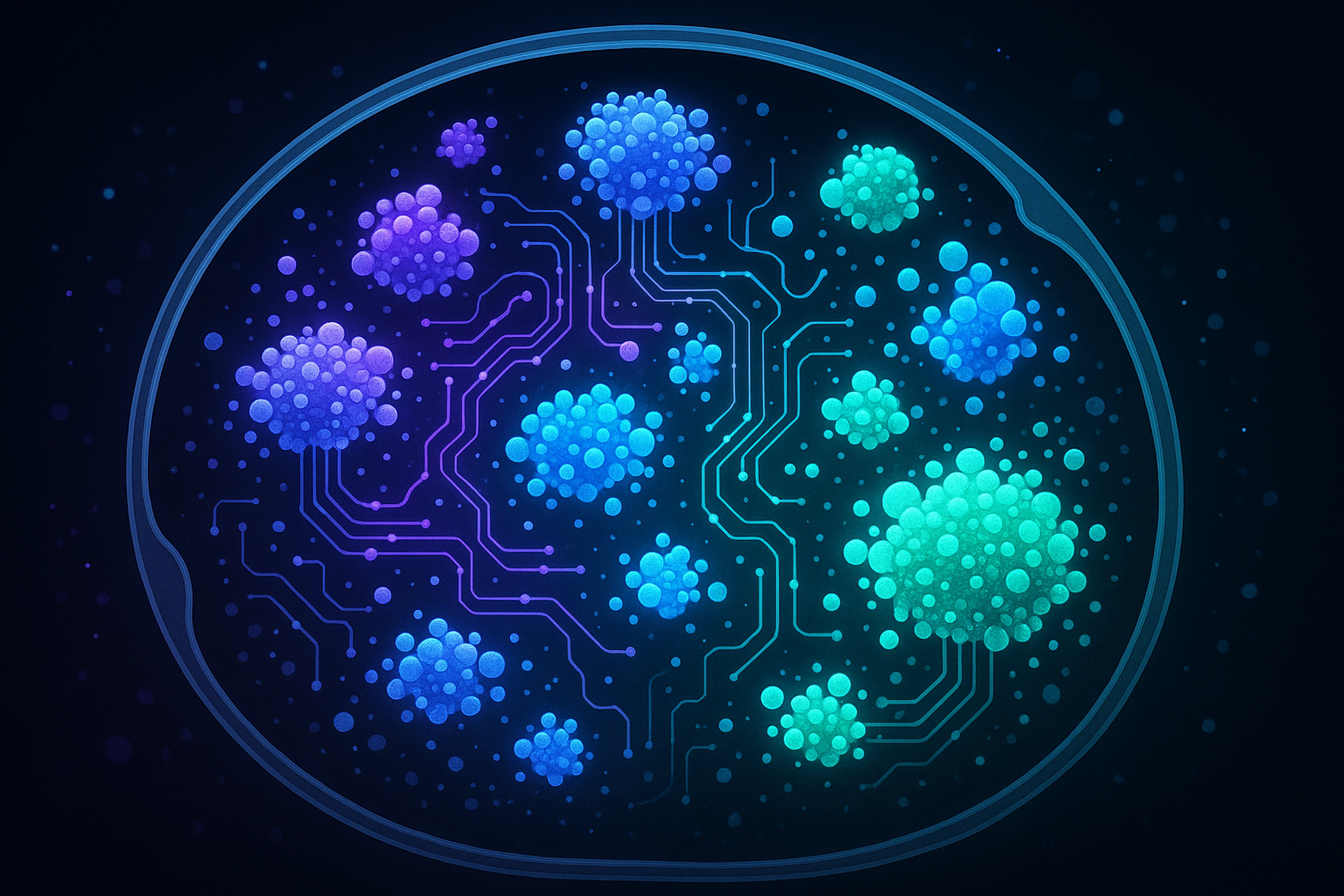
The key insight is that cells can create distinct zones through phase transitions, much like how water vapor condenses into droplets on a cold window. In cells, certain molecules can rapidly cluster together when conditions are right, forming what scientists call biomolecular condensates.
These condensates act like biological switches. When environmental conditions change, molecules can rapidly cluster or disperse, effectively turning cellular processes on or off. It's similar to how a light switch instantly changes the state of a room, rather than gradually dimming like a chemical reaction might do.
The Network Effect
What makes this discovery particularly exciting is how these physical interactions create networks. The researchers developed a theoretical framework showing that networks of physical interactions between molecules could work alongside traditional chemical signaling pathways.
Think of it like having both email and instant messaging for communication. Chemical reactions are like email: reliable but sometimes slow. Phase transitions are like instant messaging: rapid responses for urgent situations. Together, they give cells a more sophisticated communication system.
Energy Efficiency and Speed
One of the most compelling aspects of this proposed mechanism is its efficiency. Phase transitions require much less energy than breaking and forming chemical bonds. It's like the difference between flipping a light switch and building a new electrical circuit every time you want illumination.
The researchers propose that this system allows cells to respond rapidly to environmental changes. When a cell encounters stress, nutrients, or threats, physical interactions between molecules can instantly reorganize, creating new functional compartments or dissolving existing ones as needed.
Bridging Physics and Biology
This research represents a significant bridge between physical sciences and cell biology. By applying network theory from physics to biological systems, the team has opened up new ways of thinking about life itself.
Future Implications
If validated through experimental work, this theoretical framework could revolutionize multiple fields. In medicine, understanding these phase transition mechanisms could reveal new drug targets. Instead of trying to block specific chemical reactions, doctors might be able to influence how molecules organize themselves physically.
For engineers, this research offers inspiration for designing bio-inspired computers that use physical properties rather than just electronic ones. Imagine computers that could reorganize their own hardware in real-time, much like cells reorganizing their internal structure.
Perhaps most philosophically significant, this research suggests that the boundary between living and non-living matter might be more fluid than previously thought. If life uses the same fundamental physics principles that govern everyday phenomena like freezing and boiling, it provides new perspectives on what makes something "alive" versus merely complex chemistry.
Real-World Impact
Quick Takeaways
- Could revolutionize drug development by revealing new therapeutic targets based on physical properties rather than chemical reactions
- May inspire next-generation bio-inspired computers that reorganize their own hardware in real-time
- Offers energy-efficient mechanisms that could be applied to artificial intelligence and computing systems
- Provides new understanding of how single-celled organisms make complex decisions without nervous systems
- Could lead to synthetic biology applications where engineered cells use phase transitions for programmable responses
This research opens unprecedented opportunities in medicine and biotechnology. By understanding how cells use phase transitions to process information, researchers could develop drugs that work by influencing physical organization rather than blocking chemical reactions. This could be particularly valuable for diseases where traditional chemical approaches have failed, offering more subtle and potentially reversible interventions.
In technology, the principles discovered here could inspire entirely new computing architectures. Current computers are limited by fixed hardware, but systems based on cellular phase transitions could potentially reconfigure themselves in real-time, adapting their physical structure to different computational tasks. This bio-inspired approach might lead to more efficient artificial intelligence systems that consume far less energy than current technologies.
The implications extend to synthetic biology, where engineers could design cells that use programmable phase transitions to respond to specific environmental conditions. Such engineered organisms could serve as living sensors, environmental remediation tools, or even therapeutic agents that activate only when needed, reducing side effects and improving treatment precision.
For Researchers & Scientists - Technical Section
The researchers developed a theoretical framework connecting physical phase transitions to biological information processing through network theory. Their approach involved modeling biomolecular condensation as a computational mechanism, analyzing how networks of physical interactions between molecules could complement traditional chemical signaling pathways. The team used mathematical models to demonstrate how structural phase transitions, similar to those observed in condensed matter physics, could enable rapid cellular decision-making and environmental responses.
Methodology & Approach
Methodology & Approach
The research team employed a multidisciplinary approach combining condensed matter physics principles with cell biology. They developed mathematical models of biomolecular condensation, treating these phase transitions as information processing events rather than merely structural phenomena. The methodology involved creating network representations of molecular interactions, where nodes represent biomolecules and edges represent physical interactions that can undergo phase transitions.
The theoretical framework incorporated concepts from statistical mechanics and network theory to model how clusters of molecules form and dissolve in response to cellular conditions. The researchers analyzed the computational capacity of these phase transition networks, comparing their efficiency and speed to traditional chemical reaction networks. Their approach bridges scales from individual molecular interactions to emergent cellular behaviors, providing a comprehensive view of how physical properties might contribute to biological information processing.
Key Techniques & Methods
- Network Theory Modeling: Mathematical representation of molecular interactions as computational networks
- Phase Transition Analysis: Studying structural changes in biomolecular systems as information processing events
- Biomolecular Condensation Modeling: Theoretical framework for understanding how molecules cluster and separate
- Statistical Mechanics Applications: Using physics principles to model cellular decision-making processes
- Multiscale Analysis: Connecting individual molecular behaviors to emergent cellular properties
- Computational Capacity Assessment: Evaluating the information processing potential of phase transition networks
Key Findings & Results
- Physical phase transitions in cells can process information as efficiently as chemical reactions while using less energy
- Biomolecular condensation creates distinct cellular compartments that function as biological switches
- Networks of physical molecular interactions can complement traditional chemical signaling pathways
- Phase transition-based mechanisms enable rapid cellular responses to environmental changes in milliseconds
- The theoretical framework successfully bridges condensed matter physics with cell biology
- This mechanism could explain complex decision-making in organisms without nervous systems
Conclusions
The researchers conclude that phase transitions represent a fundamental but previously underappreciated mechanism for cellular information processing. Their theoretical framework demonstrates that physical reorganization of molecules through condensation and dissolution events can perform computational tasks comparable to chemical reaction networks, but with superior energy efficiency and response speed. This paradigm shift suggests that cells operate as sophisticated physical computers, utilizing phase transitions as a parallel processing system alongside traditional biochemical pathways. The work establishes a new foundation for understanding cellular intelligence and opens avenues for bio-inspired computing technologies.
-- readers