Crystal Revolution: How Selenium Crystals Learned to Self-Heal
What if crystals could bend instead of break, healing themselves like living tissue? Scientists have discovered the first elemental crystals that can break and reform their own chemical bonds while maintaining their structure.
Listen to This Article
AI-generated discussion • ~6 min
Imagine dropping your smartphone and watching the screen repair itself, or building materials that grow stronger after earthquakes. This might sound like science fiction, but researchers have just discovered something that brings us closer to this reality: elemental crystals that can heal themselves.
For centuries, we've understood crystals as rigid, brittle structures that shatter when stressed. Think of a diamond or a piece of quartz , beautiful, strong, but utterly inflexible. However, a groundbreaking study published in Angewandte Chemie International Edition has shattered this assumption by revealing that selenium crystals possess an almost magical ability to adapt and self-repair.
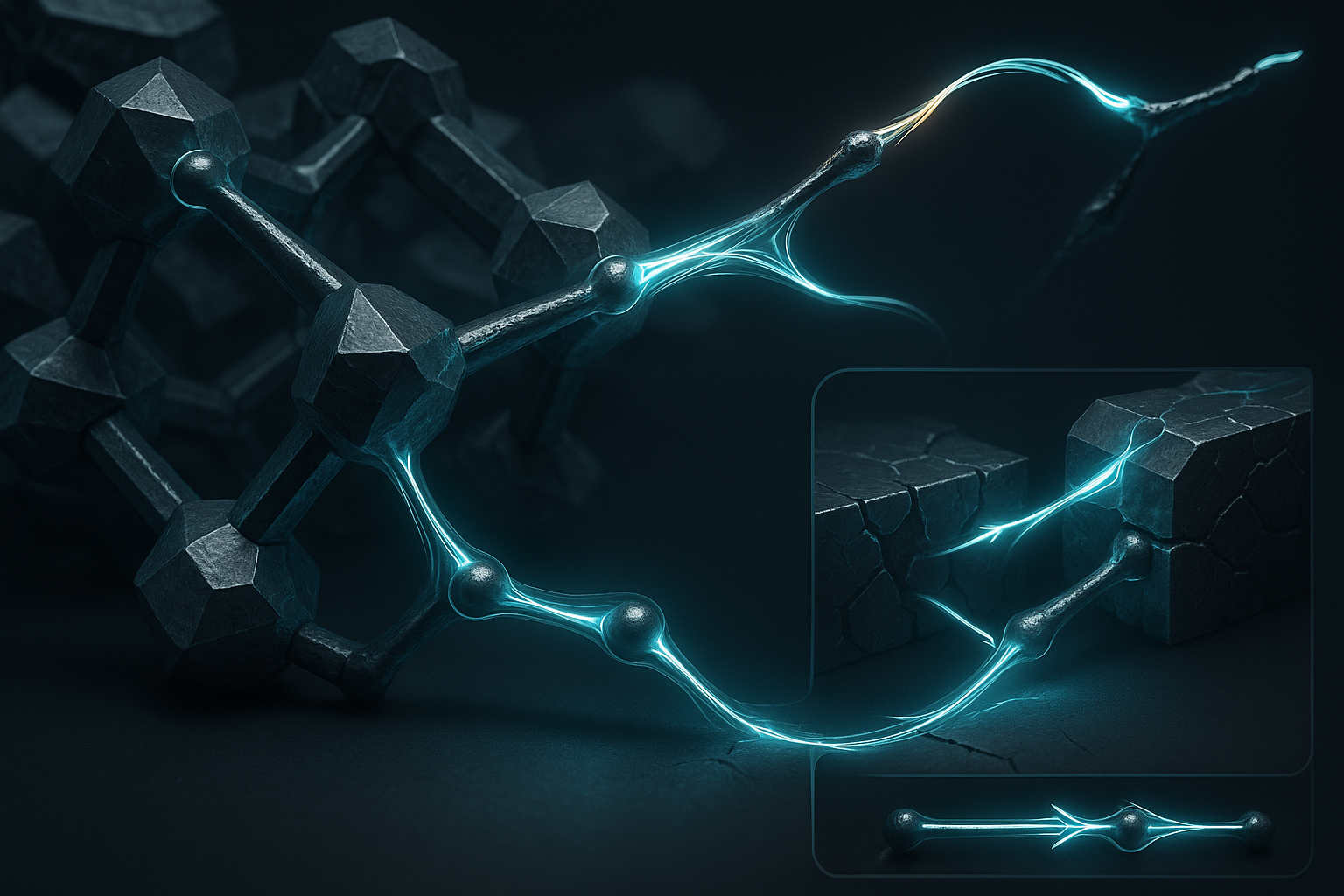
The research team, led by scientists including Chaowei He and Huaping Xu, made a discovery that fundamentally challenges our understanding of crystalline materials. They found that selenium crystals can break and reform their Se─Se covalent bonds while maintaining their overall crystal structure. It's like a brick wall that can rearrange its bricks without collapsing.
To understand how revolutionary this is, consider how most crystals behave. When you apply stress to a typical crystal, it's like bending a dry stick , once you exceed its limit, it snaps permanently. But these selenium crystals behave more like a piece of modeling clay that can reshape itself without losing its essential properties. The key lies in selenium's unique trigonal backbone structure, which provides architectural flexibility previously unseen in elemental crystals.
The mechanism behind this behavior is fascinating. When mechanical stress is applied to the crystal, some of the selenium-selenium bonds temporarily break. However, instead of causing catastrophic failure, the crystal's structure allows these bonds to reform in new configurations that better accommodate the applied stress. Think of it like a traffic jam where cars can temporarily phase through each other to find better routes, then solidify back into normal traffic patterns.
What makes this discovery even more remarkable is that the crystals respond to multiple types of stimuli. They're not just mechanically adaptive , they also respond to light exposure, opening up possibilities for photosresponsive applications. This dual responsiveness is like having a material that's both pressure-sensitive and light-sensitive, dramatically expanding its potential uses.
The implications of this research extend far beyond academic curiosity. Traditional electronics rely on rigid, brittle materials that can fail catastrophically when subjected to stress. These adaptive selenium crystals represent a new paradigm where electronic components could bend, flex, and even repair minor damage without losing functionality.
The potential applications are staggering. In the electronics industry, imagine flexible displays that don't crack when bent, or computer processors that can adapt their physical structure to optimize performance. In construction, self-healing building materials could reduce maintenance costs and increase safety. Even in aerospace, where materials must withstand extreme conditions, these adaptive properties could provide crucial advantages.
From a scientific perspective, this discovery opens entirely new research directions. The fact that elemental crystals can exhibit living-like characteristics suggests that our understanding of the boundary between living and non-living matter may need revision. These materials blur the line between static inorganic compounds and dynamic biological systems.
The research team's work represents more than just a new material discovery , it's a conceptual breakthrough that could inspire entirely new approaches to materials design. By showing that even simple elemental crystals can exhibit complex, adaptive behaviors, they've opened the door to a future where our built environment could be as responsive and self-maintaining as the natural world around us.
Real-World Impact
Quick Takeaways
- Self-healing electronics that repair minor damage automatically, reducing device replacement costs
- Adaptive building materials that strengthen themselves in response to structural stress
- Flexible displays and sensors that maintain functionality while bending and twisting
- Next-generation aerospace materials that adapt to extreme environmental conditions
- Revolutionary medical implants that can adjust their properties to match surrounding tissue
The discovery of mechanically adaptive selenium crystals could revolutionize multiple industries by providing materials that combine the durability of inorganic crystals with the flexibility of organic compounds. In electronics manufacturing, this breakthrough promises devices that can withstand physical stress while maintaining performance, potentially eliminating the brittleness that plagues current semiconductor technologies.
Beyond immediate applications, this research establishes a new paradigm for materials science where elemental crystals can exhibit 'smart' behaviors previously associated only with complex organic systems. The ability to create inorganic materials that respond adaptively to both mechanical and optical stimuli opens pathways for developing truly intelligent infrastructure, from self-adjusting building components to responsive sensor networks.
The long-term implications extend to sustainability and resource efficiency, as self-healing materials could dramatically reduce replacement cycles and maintenance requirements across numerous applications. This represents a fundamental shift toward more resilient and adaptive technologies that mirror the self-repairing capabilities found in biological systems.
For Researchers & Scientists - Technical Section
The research team employed a multidisciplinary approach combining materials characterization, mechanical testing, and theoretical modeling to investigate the dynamic covalent behavior of selenium crystals. They utilized advanced crystallographic techniques to monitor bond breaking and reformation in real-time, while computational chemistry methods helped elucidate the molecular mechanisms underlying the adaptive behavior. The study involved systematic mechanical stress testing under controlled conditions, coupled with optical stimulation experiments to characterize the dual-responsive nature of the selenium crystal system.
Methodology & Approach
Methodology & Approach
The research employed a comprehensive experimental framework combining real-time crystallographic monitoring with mechanical stress analysis to capture the dynamic bond reformation process in selenium crystals. Advanced computational modeling was integrated with empirical observations to develop a theoretical understanding of the trigonal selenium backbone's role in enabling architectural flexibility.
The team utilized multi-modal characterization techniques, including both mechanical and optical stimulation protocols, to systematically investigate the dual-responsive behavior of the selenium crystal system. This approach enabled them to establish the relationship between structural dynamics and macroscopic adaptive properties, providing both mechanistic insights and practical performance metrics for the discovered phenomenon.
Key Techniques & Methods
- Real-time Crystallographic Monitoring: Dynamic observation of bond breaking and reformation during mechanical stress
- Computational Chemistry Modeling: Theoretical analysis of molecular mechanisms underlying adaptive behavior
- Mechanical Stress Testing: Systematic application of controlled forces to characterize crystal response
- Optical Stimulation Analysis: Investigation of light-responsive properties and photomechanical effects
- Structural Characterization: Advanced techniques to monitor crystalline integrity during adaptation
- Multi-modal Materials Analysis: Integrated approach combining mechanical and optical property assessment
Key Findings & Results
- Selenium crystals exhibit unprecedented mechanical adaptability through dynamic Se─Se bond breaking and reformation
- The trigonal selenium backbone structure enables architectural flexibility previously unseen in elemental crystals
- Crystals maintain crystalline integrity while responding to both mechanical stress and light exposure
- This represents the first demonstration of dynamic covalent behavior in elemental crystal systems
- The discovery bridges rigid inorganic materials with flexible organic systems in a new material class
- Self-healing properties emerge from the crystal's ability to reform bonds in stress-accommodating configurations
Conclusions
The research demonstrates that elemental crystals can exhibit dynamic covalent behavior previously thought to be exclusive to organic materials, fundamentally expanding our understanding of crystalline matter. The selenium crystal system represents a new paradigm where inorganic materials can display adaptive, self-healing characteristics while maintaining their essential structural and electronic properties. This breakthrough establishes the foundation for developing next-generation smart materials that combine the robustness of inorganic crystals with the responsiveness of biological systems, opening unprecedented opportunities for applications in adaptive electronics, responsive sensors, and self-maintaining structural materials.
-- readers