Cellular Power Steering: How Cells Triple Their Transport Force Under Load
What if your muscles could automatically recruit extra fibers when you need to lift something heavier, without you even thinking about it?
Listen to This Article
AI-generated discussion • ~6 min
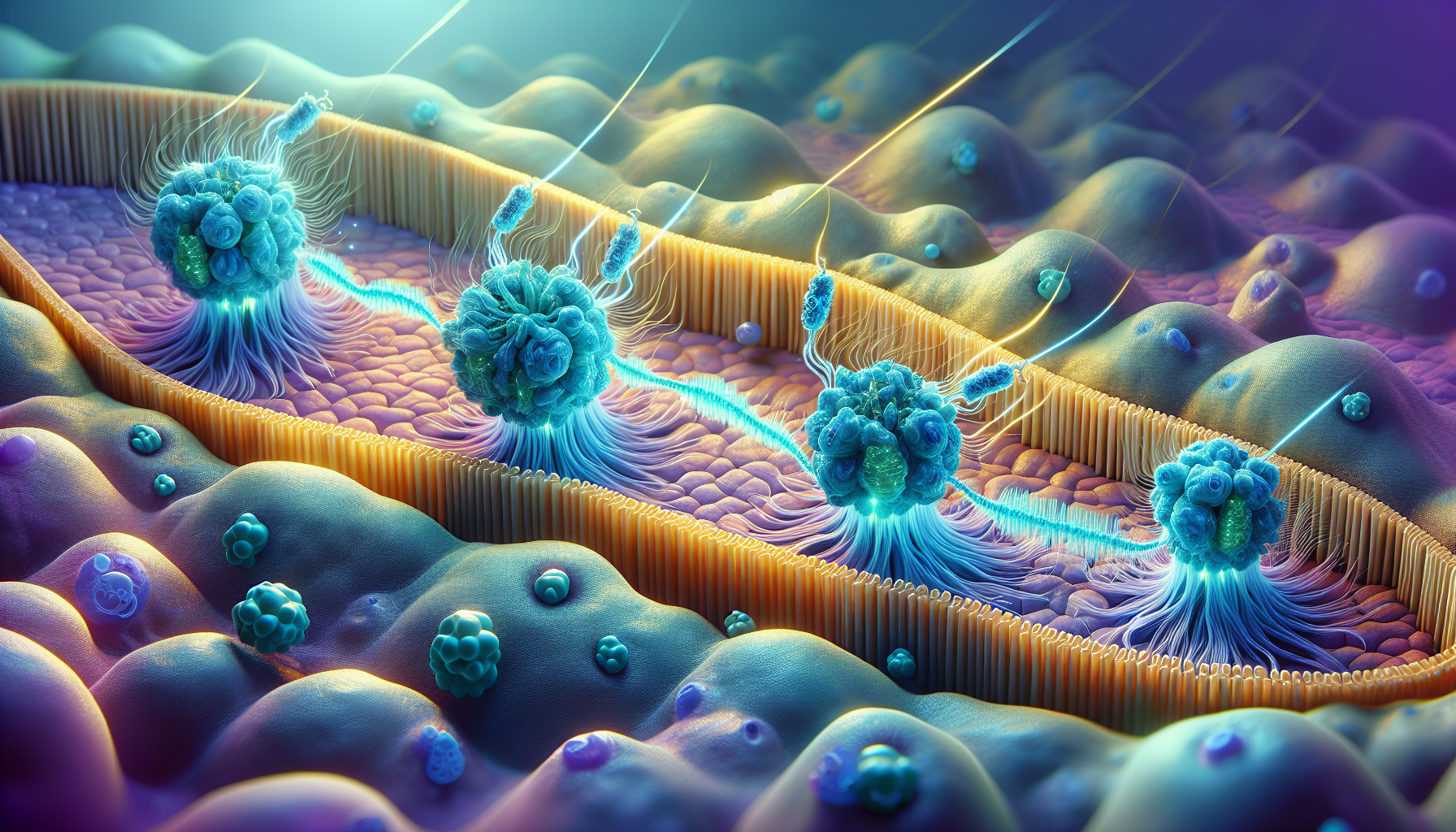
Inside every cell in your body, there's a bustling highway system more sophisticated than any human-made transport network. Tiny molecular motors called dyneins act like microscopic trucks, hauling essential cargo along protein tracks. Now, scientists have discovered something remarkable: when these cellular transporters encounter heavy loads, they can automatically call for backup.
Researchers led by Rao and colleagues have uncovered what amounts to molecular "power steering" – a system that adapts in real-time to meet varying transport demands. Published in Nature Cell Biology, this groundbreaking study reveals how cells can dynamically tune their transport machinery, much like how a car's transmission shifts gears when climbing a steep hill.
To understand this discovery, imagine a delivery company with trucks that normally work in pairs. When traffic is light and packages are small, two trucks handle the job perfectly. But when they encounter a traffic jam or need to move something particularly heavy, a third truck automatically joins the convoy. That's essentially what happens with dynein-dynactin-cargo adaptor complexes.
Under normal conditions, these transport complexes operate with two dynein motors working together. However, the research team discovered that when mechanical resistance increases – perhaps when navigating crowded cellular regions or moving particularly heavy cargo – the system recruits a third dynein motor through a clever molecular mechanism.
The recruitment happens through a secondary adaptor protein that binds to a specific part of dynein called the light intermediate chain. Think of it as having a backup coupling system that only activates under stress. This additional motor doesn't just tag along – it provides genuine extra power when the cellular going gets tough.
The force measurements are striking. A single dynein motor working with a helper protein called Lis1 generates approximately 4.5 piconewtons of force. Two dyneins working together bump that up to about 7 piconewtons. But when a third dynein joins the team, the force reaches approximately 9 piconewtons – not quite triple the single motor's output, but a substantial boost when it matters most.
Lis1 plays a crucial role as a molecular switch. Without it, dynein tends to fold into what scientists call a "phi-like" conformation – essentially an inactive, self-inhibited state where the motor curls up on itself and can't generate much force. Lis1 prevents this cellular equivalent of a motor stalling, keeping dynein in its active, force-generating configuration.
Perhaps most intriguingly, the research revealed that under load, these three-motor complexes primarily take steps of 8 nanometers along the cellular tracks. This finding challenges existing models of how multiple motors coordinate their movements, suggesting the cellular transport system is even more sophisticated than previously thought.
This discovery represents a fundamental shift in how we understand cellular transport. Rather than being a rigid system with fixed capabilities, cellular transport machinery emerges as an adaptive, responsive network that can dynamically adjust to meet varying demands. It's molecular engineering at its finest – a system that automatically optimizes itself for efficiency and power as conditions change.
The implications extend far beyond basic cell biology. Understanding how cells normally adapt their transport systems could provide crucial insights into what goes wrong in diseases where cellular transport breaks down, particularly neurodegenerative conditions where efficient cargo delivery is essential for cell survival.
Real-World Impact
Quick Takeaways
- Could lead to new therapeutic targets for neurodegenerative diseases like Alzheimer's and ALS
- Provides insights for designing adaptive molecular machines and nanotechnology applications
- Explains how cells maintain efficient transport in crowded, dynamic environments
- May inform development of artificial cellular transport systems for biotechnology
- Advances understanding of fundamental cellular processes essential for life
This discovery has profound implications for understanding and treating diseases where cellular transport fails. Neurodegenerative diseases like Alzheimer's, Parkinson's, and ALS often involve breakdowns in the cellular transport system, leading to the accumulation of toxic proteins and eventual cell death. By revealing how healthy cells adapt their transport machinery under stress, this research provides new targets for therapeutic intervention.
Beyond medicine, the findings could revolutionize the design of artificial molecular machines and nanotechnology applications. Engineers working on drug delivery systems, molecular robots, or other nanoscale devices could incorporate similar adaptive mechanisms to create more robust and efficient systems. The research also advances our fundamental understanding of how cells maintain organization and function in the face of constantly changing conditions.
The discovery challenges the traditional view of cellular machinery as static, revealing instead a dynamic system capable of real-time optimization – a principle that could inform everything from bioengineering to the development of self-adapting materials and systems.
For Researchers & Scientists - Technical Section
Rao et al. employed single-molecule biophysics techniques and optical trapping to investigate dynein-dynactin-cargo adaptor complex mechanics under varying load conditions. The research utilized precise force measurements and step-size analysis to characterize the recruitment of additional dynein motors via secondary adaptor proteins binding to light intermediate chains, demonstrating load-dependent assembly of three-dynein complexes with enhanced force generation capabilities.
Methodology & Approach
Methodology & Approach
The research team utilized sophisticated single-molecule biophysics techniques to investigate the mechanical properties of dynein-dynactin-cargo adaptor complexes under varying load conditions. Optical trapping methods allowed precise measurement of forces generated by individual motor complexes, enabling quantification of force output from one, two, and three-dynein assemblies.
The experimental design incorporated systematic analysis of complex assembly under different mechanical tensions, revealing the load-dependent recruitment mechanism. Step-size analysis provided insights into motor coordination, while structural studies of the Lis1-dynein interaction elucidated the molecular basis for preventing the force-limiting phi-like conformation. The methodology combined real-time force measurements with detailed analysis of motor stepping behavior to provide comprehensive characterization of the adaptive transport mechanism.
Key Techniques & Methods
- Single-molecule optical trapping: Precise measurement of piconewton-level forces generated by individual motor complexes
- Step-size analysis: Quantification of 8-nanometer steps taken by three-motor complexes under load
- Force spectroscopy: Systematic measurement of force generation across different dynein configurations
- Protein-protein interaction assays: Investigation of secondary adaptor binding to light intermediate chains
- Structural analysis: Examination of Lis1-dynein interactions and phi-like conformation prevention
- Load-dependent assembly studies: Analysis of motor recruitment under varying mechanical resistance
Key Findings & Results
- Three-dynein complexes form under mechanical tension via secondary adaptor protein recruitment
- Single dynein with Lis1 generates ~4.5 piconewtons, two dyneins ~7 pN, three dyneins ~9 pN
- Secondary adaptor proteins bind to dynein light intermediate chains to enable third motor recruitment
- Lis1 prevents dynein from entering force-limiting phi-like autoinhibited conformation
- Under load, three-motor complexes primarily take 8-nanometer steps along microtubules
- Load-dependent motor recruitment represents dynamic adaptation of cellular transport machinery
Conclusions
The study demonstrates that dynein-dynactin-cargo adaptor complexes possess sophisticated load-sensing and adaptive capabilities, enabling dynamic recruitment of additional motors to meet mechanical demands. This represents a paradigm shift from viewing cellular transport as static to understanding it as a responsive, self-optimizing system. The findings have significant implications for understanding transport-related pathologies and designing biomimetic molecular machines with adaptive force-generation capabilities.
-- readers