The Mirror Flaw: How Gravitational Wave Detectors Got Their Physics Wrong
For decades, scientists assumed the mirror coatings in gravitational wave detectors were perfectly uniform. They were wrong, and this mistake might explain why our most sensitive instruments hit unexpected limits.
Listen to This Article
AI-generated discussion • ~6 min
Imagine trying to hear a whisper from across a crowded stadium while wearing earplugs. That's essentially what gravitational wave detectors like LIGO do every day, except they're listening for cosmic whispers from black hole collisions billions of light-years away. These instruments are so sensitive they can detect distortions smaller than 1/10,000th the width of a proton. Yet for all their incredible precision, scientists have been making a fundamental mistake about how they work.
A groundbreaking study published in Physical Review X reveals that the mirror coatings essential to these detectors behave very differently than physicists assumed for decades. The research team, led by Brenda Bracco and colleagues from multiple institutions, discovered that these materials have anisotropic properties, meaning they act differently depending on which direction you measure them.
The Foundation of Gravitational Wave Detection
Gravitational wave detectors work by splitting laser light and sending it down two perpendicular arms, each stretching several kilometers. When a gravitational wave passes through, it slightly stretches space in one direction while compressing it in the other. The laser light traveling these paths returns at slightly different times, creating an interference pattern that reveals the wave's presence.
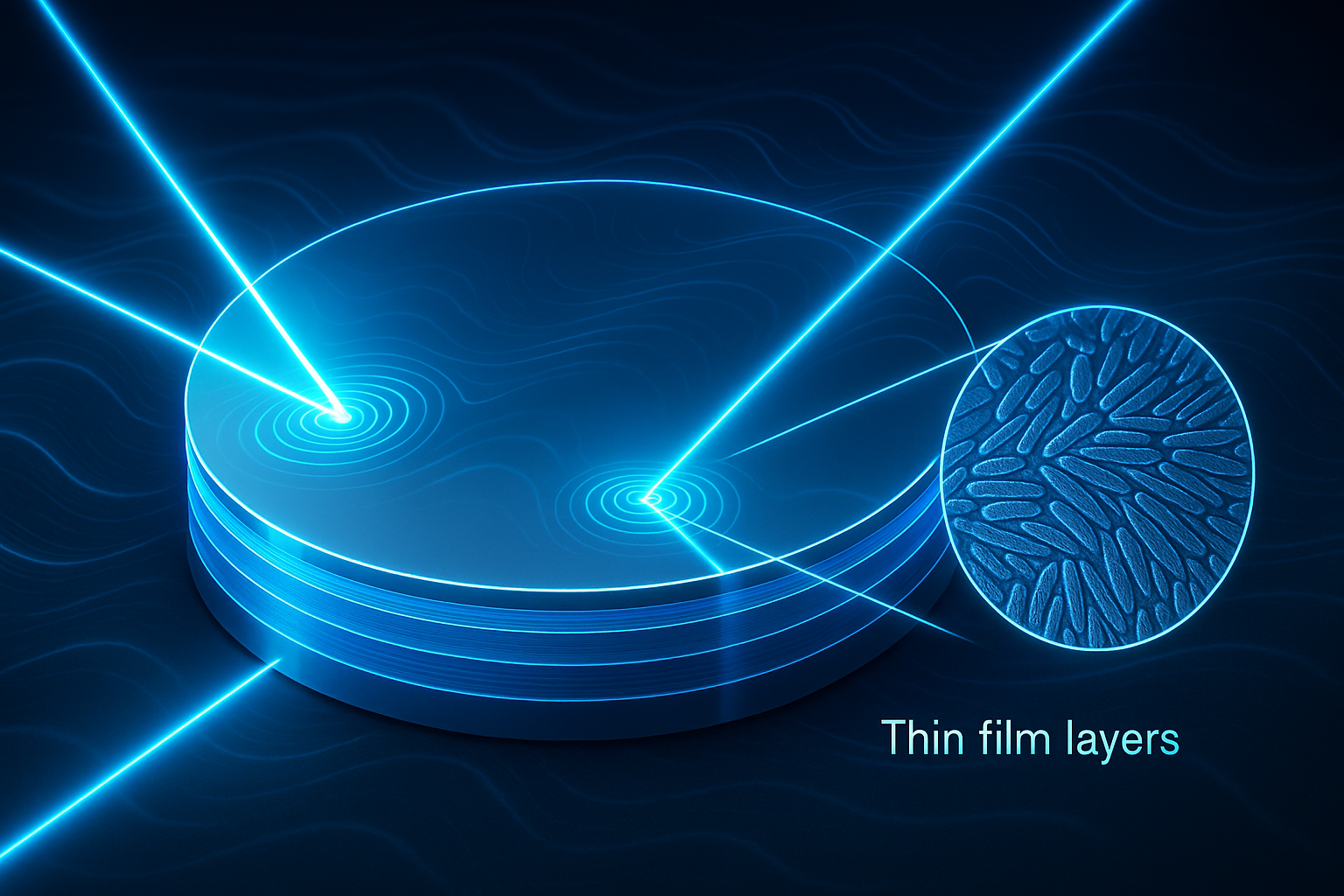
The mirrors that reflect this laser light are coated with incredibly thin layers of materials like silica. These coatings, each layer just nanometers thick, are crucial because they determine how much thermal noise the mirrors produce. Think of it like trying to measure tiny vibrations while standing on a shaking platform, the mirror coatings are that platform.
The Research Revolution
The research team used a technique called Brillouin light scattering to probe the elastic properties of ion-beam-sputtered silica films. It's like using sonar to map the ocean floor, but instead of sound waves, they used light waves to map the internal structure of these ultra-thin coatings.
What they found challenged decades of assumptions. The coatings weren't uniform and isotropic as everyone believed. Instead, they showed clear directional preferences, like wood grain that makes timber stronger along certain axes. The ion-beam sputtering process used to create these coatings apparently creates structural patterns that influence how the material behaves.
Why This Changes Everything
This discovery has profound implications for gravitational wave astronomy. All theoretical models used to predict thermal noise have assumed these materials are perfectly uniform. If the materials are actually anisotropic, it means scientists have been using the wrong equations to calculate detector sensitivity limits.
Think of it like discovering that your car's speedometer has been miscalibrated for years. You thought you knew how fast you could go, but the real limits are different than you calculated. For gravitational wave detectors, this could explain why some sensitivity improvements haven't met theoretical predictions.
The Path Forward
Understanding the true nature of these coating materials opens new possibilities for improving gravitational wave detectors. Future third-generation detectors like Einstein Telescope and Cosmic Explorer could benefit from coatings engineered to take advantage of these directional properties rather than ignoring them.
Better gravitational wave detectors mean we can detect more distant cosmic events, observe smaller black holes, and potentially discover entirely new types of astronomical phenomena. Every improvement in sensitivity exponentially increases the volume of space we can monitor, like upgrading from a small fishing net to a massive trawl.
This research represents more than just a technical correction, it's a reminder that even our most sophisticated instruments still hold surprises. As we push the boundaries of measurement precision, we must continually question our assumptions about how the universe and our tools actually work.
Real-World Impact
Quick Takeaways
- Corrects decades of incorrect assumptions about gravitational wave detector mirror coatings
- Could explain why some detector sensitivity improvements fell short of theoretical predictions
- Opens pathways for engineering better coatings in future third-generation detectors
- May enable detection of more distant cosmic events and smaller gravitational wave sources
- Provides new techniques for characterizing ultra-thin film properties in other precision instruments
This discovery fundamentally changes how scientists approach gravitational wave detector design and optimization. By revealing that mirror coatings have directional properties, researchers can now develop more accurate models for thermal noise, potentially leading to significant sensitivity improvements in future detectors. The implications extend beyond current facilities like LIGO and Virgo to next-generation instruments like Einstein Telescope and Cosmic Explorer.
The research also establishes new methodologies for characterizing ultra-thin films that could benefit other precision measurement fields, from atomic clocks to quantum sensors. Understanding the true structural properties of these materials may unlock engineering approaches that deliberately exploit anisotropic properties to reduce thermal noise, rather than incorrectly assuming uniformity.
More sensitive gravitational wave detectors could revolutionize our understanding of the universe by detecting previously unobservable phenomena, from primordial black holes to cosmic strings, while providing unprecedented tests of general relativity in extreme gravitational fields.
For Researchers & Scientists - Technical Section
The research team employed Brillouin light scattering spectroscopy to characterize the elastic properties of ion-beam-sputtered silica thin films used in gravitational-wave detector mirror coatings. This represented the first explicit experimental verification of isotropy assumptions that have underpinned theoretical models for decades. The methodology involved advanced spectroscopic analysis to measure directional elastic properties with unprecedented precision in ultra-thin film samples.
Methodology & Approach
Methodology & Approach
The research utilized Brillouin light scattering (BLS) spectroscopy as the primary characterization technique, enabling non-destructive measurement of elastic properties in ion-beam-sputtered silica films. The team developed advanced analytical protocols to measure directional elastic constants with precision sufficient to detect anisotropic behavior in ultra-thin coatings typically assumed to be isotropic.
Sample preparation involved ion-beam sputtering deposition techniques commonly used in gravitational-wave detector manufacturing, ensuring experimental relevance to operational systems like LIGO. The spectroscopic analysis incorporated sophisticated data processing algorithms to extract quantitative elastic property measurements from light scattering signatures, providing the first comprehensive elastic characterization of these critical detector components.
Key Techniques & Methods
- Brillouin Light Scattering Spectroscopy: Non-destructive optical technique for measuring elastic properties through laser light interaction with acoustic phonons
- Ion-Beam Sputtering Deposition: Manufacturing process for creating ultra-thin mirror coatings by bombarding target materials with ion beams
- Elastic Constant Analysis: Mathematical framework for quantifying directional mechanical properties in thin film materials
- Anisotropy Characterization: Experimental methods for detecting and measuring directional property variations in presumably uniform materials
- Thermal Noise Modeling: Theoretical calculations linking material elastic properties to detector sensitivity limitations
- Ultra-Thin Film Spectroscopy: Specialized optical measurement techniques for characterizing nanometer-scale coating layers
Key Findings & Results
- Mirror coating materials exhibit measurable anisotropic elastic properties contradicting isotropy assumptions
- Ion-beam sputtering creates structural patterns that influence directional material behavior
- Current theoretical thermal noise models incorrectly assume homogeneous and isotropic material properties
- Brillouin light scattering can detect elastic anisotropy in ultra-thin films with unprecedented precision
- The anisotropic properties affect thermal noise calculations critical for gravitational-wave detector sensitivity
- This represents the first explicit experimental verification of coating isotropy assumptions in detector design
Conclusions
The study conclusively demonstrates that ion-beam-sputtered silica thin films exhibit elastic anisotropy that has been overlooked in gravitational-wave detector thermal noise calculations for decades. This finding necessitates revision of theoretical models and suggests that understanding and potentially exploiting these anisotropic properties could lead to significant improvements in detector sensitivity. The developed characterization techniques provide essential tools for future coating optimization and third-generation detector development.
-- readers