The Birth of Complex Life: Scientists Map Evolution's Greatest Transformation
What if we could rewind the clock billions of years to witness the exact sequence of events that transformed simple cells into all complex life on Earth?
Listen to This Article
AI-generated discussion • ~5 min
Every cell in your body tells an ancient story, one that began over a billion years ago when a dramatic transformation gave rise to all complex life on Earth. Now, scientists have managed to reconstruct this evolutionary epic by analyzing the genetic fingerprints left behind in thousands of gene families across diverse organisms. The results? A surprising timeline that challenges what we thought we knew about life's greatest upgrade.
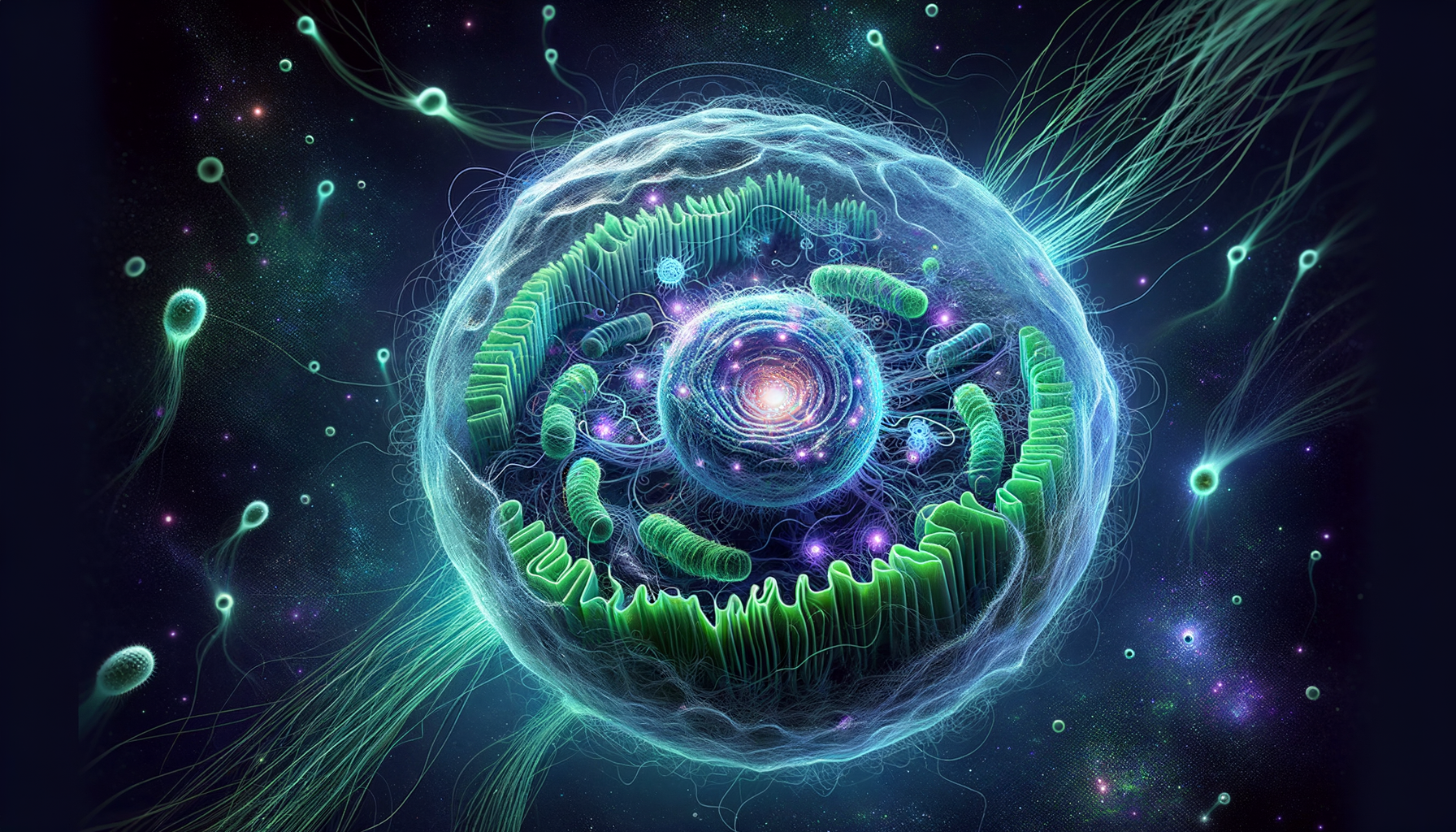
The research focuses on eukaryogenesis, the birth of eukaryotic cells, which are the complex cells that make up animals, plants, fungi, and many microscopic organisms. Unlike simple bacterial cells, eukaryotes are cellular mansions with specialized rooms: a nucleus housing genetic material, an intricate endomembrane system for processing molecules, a dynamic cytoskeleton providing structure, and most famously, mitochondria, the powerhouse organelles that generate energy.
For decades, scientists have debated which came first: the chicken or the egg? In this case, the question was whether the nucleus evolved before or after the acquisition of mitochondria through endosymbiosis. Traditional theories often assumed these events happened simultaneously or that mitochondria came first, providing the energy needed for cellular complexity.
The researchers used a clever approach: treating gene duplications as evolutionary timestamps. When genes duplicate, they create copies that can evolve independently. By using molecular clock dating on thousands of gene families, the team could determine when specific cellular innovations appeared. Think of it like archaeological carbon dating, but for genetic material, each duplication event leaves a mark that can be dated relative to other events.
The findings paint a radically different picture of eukaryotic evolution. Many "eukaryotic signature proteins", the molecular machinery that defines complex cells, appeared before mitochondria entered the scene. The nucleus, endomembrane system, and sophisticated cytoskeleton were already developing in what researchers call the "pre-mitochondrial eukaryote." This ancestral cell was already surprisingly complex before it acquired its bacterial partner.
Imagine building a house: the traditional view suggested someone moved into a tent, got a powerful generator (mitochondria), and then used that power to build a mansion around it. The new evidence suggests the mansion's foundation, walls, and rooms were already under construction before the generator arrived. The mitochondrial acquisition was certainly transformative, providing abundant energy, but it wasn't the initial spark that started eukaryotic complexity.
The researchers employed phylogenomic analysis to trace the ancestry of genes across the tree of life, combined with ancestral genome reconstruction to peer into deep evolutionary time. By examining which genes appeared in which order, they assembled a temporal sequence of evolutionary innovations spanning hundreds of millions of years.
This timeline reveals that eukaryogenesis wasn't a single dramatic event but an extended process of gradual assembly. The nucleus likely evolved to protect genetic material from damage, while the endomembrane system developed for more sophisticated molecular processing. Only later did mitochondria join this increasingly complex cellular architecture, supercharging the energy budget and enabling even greater complexity.
The implications extend beyond mere evolutionary curiosity. Understanding how complexity arose from simplicity, how modular cellular systems assembled themselves over deep time, provides insights into the fundamental principles of biological organization. It reminds us that evolution is a tinkerer, building new innovations from existing parts, often in surprising sequences. The birth of complex life wasn't destiny but a contingent series of events that happened to work out extraordinarily well, ultimately giving rise to the spectacular diversity of life we see today.
Real-World Impact
Quick Takeaways
- Rewrites the timeline of eukaryotic evolution, showing nuclear and cellular complexity evolved before mitochondrial acquisition
- Provides new framework for understanding how biological complexity emerges through modular assembly
- Offers insights for synthetic biology efforts to engineer complex cellular systems from simpler components
- Informs search for extraterrestrial life by clarifying which evolutionary steps are prerequisites for complexity
This research fundamentally changes our understanding of one of evolution's most important transitions, the origin of complex cells. By establishing that many hallmark eukaryotic features evolved before the mitochondrial endosymbiosis, it suggests that cellular complexity can arise through gradual innovation rather than requiring a single transformative event. This has profound implications for understanding evolutionary processes and the conditions necessary for complex life to emerge.
For synthetic biology and bioengineering, the findings provide a roadmap for how cellular complexity can be built modularly. Understanding the sequence in which cellular systems evolved, and which innovations are prerequisites for others, could guide efforts to engineer artificial cells or enhance existing cellular capabilities. The research also informs astrobiology by clarifying which evolutionary steps might be common versus rare in the universe, helping scientists assess the likelihood of finding complex life beyond Earth.
More broadly, the work demonstrates the power of genomic archaeology, using computational analysis of modern genomes to reconstruct ancient evolutionary events. As genomic databases grow and analytical techniques improve, we can expect increasingly detailed reconstructions of life's history, potentially answering longstanding questions about other major evolutionary transitions and the deep relationships among all living things.
For Researchers & Scientists - Technical Section
This study employs cutting-edge phylogenomic methods to date gene duplication events across eukaryotic lineages, providing unprecedented temporal resolution of the evolutionary assembly of eukaryotic cells. By analyzing thousands of gene families and applying molecular clock calibrations, the researchers reconstructed the sequence in which key eukaryotic features, the nucleus, endomembrane system, cytoskeleton, and mitochondria, were acquired during eukaryogenesis.
Methodology & Approach
Methodology & Approach
The research team assembled a comprehensive dataset of gene families from hundreds of eukaryotic species spanning all major lineages, along with prokaryotic outgroups. They employed sophisticated phylogenetic reconstruction methods to infer gene family trees, identifying duplication events that occurred at different points in eukaryotic evolution. By mapping these duplications onto the species tree and applying molecular clock models calibrated with fossil and biogeochemical data, they established relative and absolute timing for when different gene families expanded.
A critical component of the methodology was ancestral genome reconstruction, which computationally infers the gene content of extinct ancestral organisms. By determining which genes were present in the last eukaryotic common ancestor (LECA) and its predecessors, the researchers could establish temporal layers of innovation. They cross-validated their molecular dating with functional annotations, examining when genes associated with specific cellular structures (nuclear pore complexes, endomembrane trafficking, cytoskeletal motors, mitochondrial import machinery) first appeared. This multi-layered approach provided robust evidence for the pre-mitochondrial origin of many eukaryotic signature proteins.
Key Techniques & Methods
- Molecular Clock Dating: Applied relaxed molecular clock models to gene family phylogenies, calibrating substitution rates using fossil evidence and biomarkers to estimate absolute timing of duplication events
- Phylogenomic Analysis: Constructed large-scale phylogenetic trees from thousands of gene families across diverse eukaryotes and prokaryotic relatives to trace evolutionary relationships
- Ancestral Genome Reconstruction: Computationally inferred gene content of extinct ancestral organisms by mapping gene presence/absence onto species trees and reconstructing ancestral states
- Gene Family Classification: Systematically categorized genes by cellular function (nuclear, endomembrane, cytoskeletal, mitochondrial) to identify when specific cellular systems evolved
- Comparative Genomics: Analyzed gene family expansions and contractions across lineages to identify eukaryotic signature proteins and their evolutionary origins
- Bayesian Statistical Methods: Employed Bayesian inference frameworks to account for uncertainty in phylogenetic relationships, divergence times, and ancestral reconstructions
Key Findings & Results
- Many eukaryotic signature proteins, including components of the nucleus and endomembrane system, evolved before the mitochondrial endosymbiosis event
- The nuclear envelope and nuclear pore complex machinery show pre-mitochondrial origins, suggesting nuclear compartmentalization preceded mitochondrial acquisition
- Cytoskeletal complexity, including sophisticated motor proteins and regulatory systems, was already developing in pre-mitochondrial ancestors
- Mitochondrial acquisition occurred later in the eukaryogenic timeline than traditionally assumed, supercharging an already complex cellular architecture
- Gene duplication rates show distinct temporal patterns, with major expansion phases corresponding to acquisition of different cellular systems
- The timeline reveals eukaryogenesis as an extended process spanning potentially hundreds of millions of years rather than a single dramatic event
Conclusions
This work provides the most detailed temporal reconstruction of eukaryogenesis to date, challenging conventional models that place mitochondrial acquisition as the primary driver of eukaryotic complexity. The findings demonstrate that substantial cellular innovation preceded endosymbiosis, suggesting that the pre-mitochondrial ancestor was already a complex organism with nuclear compartmentalization, endomembrane trafficking, and cytoskeletal sophistication. The mitochondrial acquisition subsequently amplified metabolic capacity, enabling further elaboration of existing systems. These insights reshape our understanding of how biological complexity evolves and highlight the importance of modular innovation in major evolutionary transitions. Future work integrating additional genomic data and improved calibration points will further refine this evolutionary timeline.
-- readers