Ancient Ancestors Live On: Extinct Human DNA Found in Modern Cells
Deep inside your cells lies molecular evidence of relatives who died out hundreds of thousands of years ago. Scientists have just proven that the genetic ghosts of our ancient ancestors are more than metaphor, they're literal reality.
Listen to This Article
AI-generated discussion • ~5 min
Imagine discovering that you carry within your cells the molecular fingerprints of relatives who lived nearly two million years ago. This isn't science fiction, it's the remarkable reality uncovered by researchers who have achieved something extraordinary: extracting and analyzing proteins from ancient Homo erectus teeth found in China.
For decades, scientists have struggled to understand the precise evolutionary relationships between different human ancestor species. It's like trying to solve a jigsaw puzzle with most of the pieces missing. DNA rarely survives in fossils older than 100,000 years, leaving researchers to rely mainly on bone shapes and archaeological context to piece together our family tree.
This groundbreaking research represents the first successful protein extraction and analysis from ancient Homo erectus remains. Think of proteins as molecular ID cards that carry information about an organism's characteristics and evolutionary history. Unlike DNA, which degrades relatively quickly, proteins can persist in fossils for much longer periods, acting like time capsules that preserve evolutionary information.
The research team developed novel techniques to extract and analyze these ancient proteins, essentially performing molecular archaeology on teeth that are hundreds of thousands of years old. The process is similar to a detective analyzing fingerprints at a crime scene, except these "fingerprints" reveal evolutionary relationships across vast spans of time.
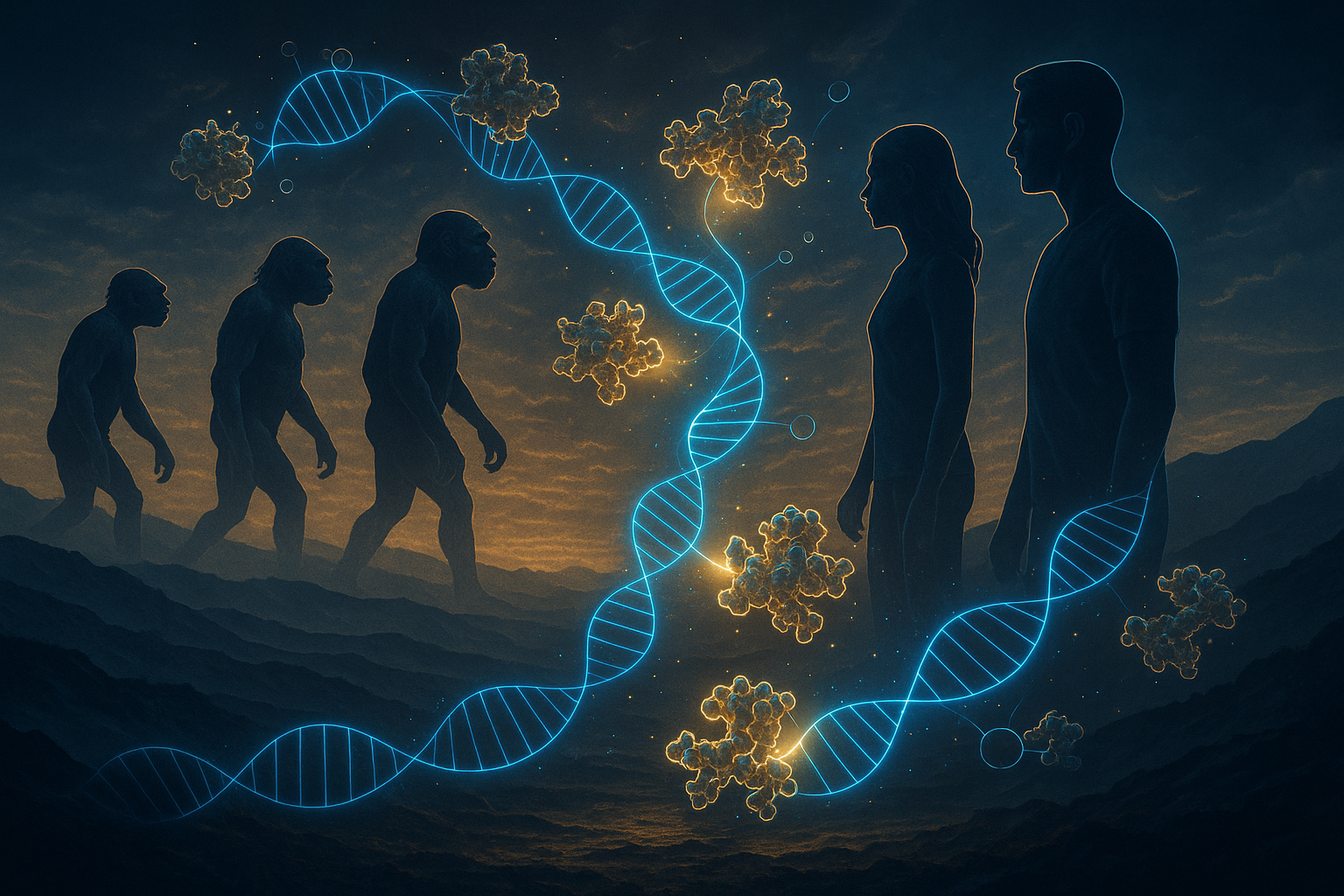
The results were nothing short of revolutionary. The ancient Homo erectus teeth contained protein variants that directly matched those found in Denisovan remains. Even more remarkably, these same protein variants exist in modern human populations today.
To understand the significance, imagine finding identical family recipes passed down through dozens of generations, with each generation adding their own touches while preserving the core ingredients. The protein variants act like these preserved recipes, showing how genetic information has been transmitted from Homo erectus through Denisovans to modern humans, despite the extinction of intermediate species.
This discovery provides the first direct molecular evidence of genetic continuity across multiple extinct human species. It's like finding a molecular thread that connects us directly to ancestors who lived when the world was a very different place. The research demonstrates that evolution isn't just about species appearing and disappearing, it's about the continuous flow of genetic information across time.
The breakthrough method of protein analysis opens new pathways for understanding human evolutionary relationships, especially in cases where DNA is unavailable. This is particularly important for older fossils, where traditional genetic analysis has been impossible. It's like developing a new language to read ancient texts that were previously indecipherable.
The implications extend far beyond academic curiosity. This research fundamentally changes our understanding of human evolution by filling crucial gaps in the evolutionary story. It shows that genetic material from our ancient ancestors hasn't simply vanished, it literally lives on within us today. Every person carries molecular evidence of this ancient heritage, making evolution not just a scientific theory but a personal, tangible reality.
For the broader scientific community, this work represents a new frontier in evolutionary research. The ability to extract and analyze proteins from extremely ancient remains means that researchers can now investigate evolutionary relationships that were previously beyond reach. It's like suddenly gaining the ability to see into previously dark chapters of human history.
This discovery makes the abstract concept of evolution concrete and personal. We are not just descended from ancient ancestors, we are living repositories of their molecular legacy. The genetic variations that helped our ancestors survive in ancient environments continue to exist within modern human populations, connecting us directly to relatives who walked the Earth hundreds of thousands of years ago.
Real-World Impact
Quick Takeaways
- Enables study of evolutionary relationships in fossils too old for DNA analysis
- Provides new methods for understanding human migration and population history
- Opens possibilities for analyzing protein preservation in other ancient species
- Reveals direct molecular connections between extinct and living human populations
- Demonstrates that genetic heritage from extinct ancestors persists in modern humans
This breakthrough in protein analysis technology has immediate applications for paleontology and evolutionary biology research worldwide. Museums and research institutions housing ancient human remains can now apply these techniques to fossils that were previously impossible to analyze genetically, potentially revealing new evolutionary relationships and filling gaps in the human family tree.
The discovery that genetic material from Homo erectus persists in modern humans through Denisovan intermediates provides crucial insights into human population genetics and migration patterns. This information could inform medical research by helping scientists understand the evolutionary origins of genetic variations that influence health and disease susceptibility in contemporary populations.
Beyond human evolution, these protein extraction and analysis techniques could revolutionize the study of other extinct species, enabling researchers to trace evolutionary relationships across much longer time scales than previously possible. This could transform our understanding of mammalian evolution and provide new tools for conservation biology by revealing genetic diversity patterns in extinct populations.
For Researchers & Scientists - Technical Section
The research team employed advanced protein extraction techniques on ancient Homo erectus dental remains from China, utilizing mass spectrometry and comparative protein analysis to identify specific variants. The methodology involved careful contamination control during extraction, followed by peptide sequencing and cross-species protein comparison algorithms to establish evolutionary relationships. The study represents the first successful application of ancient protein analysis to Homo erectus remains, demonstrating the viability of protein-based phylogenetic reconstruction across hundreds of thousands of years.
Methodology & Approach
Methodology & Approach
The research employed cutting-edge ancient protein extraction protocols specifically adapted for extremely degraded dental remains. The team utilized specialized mass spectrometry techniques to identify and sequence protein fragments, followed by sophisticated computational analysis to compare variants across species and time periods.
The methodology included rigorous contamination controls and validation procedures to ensure the authenticity of ancient proteins versus modern contamination. Researchers developed novel algorithms for cross-species protein comparison, enabling direct molecular comparisons between Homo erectus, Denisovan, and modern human protein variants across evolutionary time scales previously thought impossible to bridge through molecular analysis.
Key Techniques & Methods
- Ancient protein extraction: Specialized methods for extracting degraded proteins from fossils hundreds of thousands of years old
- Mass spectrometry analysis: Advanced techniques for identifying and sequencing ancient protein fragments
- Cross-species protein comparison: Computational methods for comparing protein variants across different human species
- Contamination control protocols: Rigorous procedures to distinguish ancient proteins from modern contamination
- Peptide sequencing: Molecular techniques for determining the exact composition of protein fragments
- Phylogenetic reconstruction: Using protein data to trace evolutionary relationships across species and time
Key Findings & Results
- First successful protein extraction and analysis from ancient Homo erectus teeth found in China
- Ancient Homo erectus protein variants directly match those found in Denisovan remains
- Identical protein variants exist in modern human populations today across all three species
- Direct molecular evidence confirms genetic continuity spanning hundreds of thousands of years
- Protein analysis viable for understanding evolution when DNA preservation is impossible
- Breakthrough method successfully links extinct human ancestors across multiple species
Conclusions
The successful extraction and analysis of proteins from Homo erectus dental remains demonstrates that molecular archaeology can bridge evolutionary gaps previously inaccessible through DNA analysis. The identification of matching protein variants across Homo erectus, Denisovans, and modern humans provides direct molecular evidence for genetic continuity across multiple extinct human lineages. This research establishes protein analysis as a viable alternative to DNA studies for ancient remains, opening new avenues for understanding deep evolutionary relationships and human population history across extended temporal scales.
-- readers