The Potato Revolution: How Removing Flowers Could Feed Billions
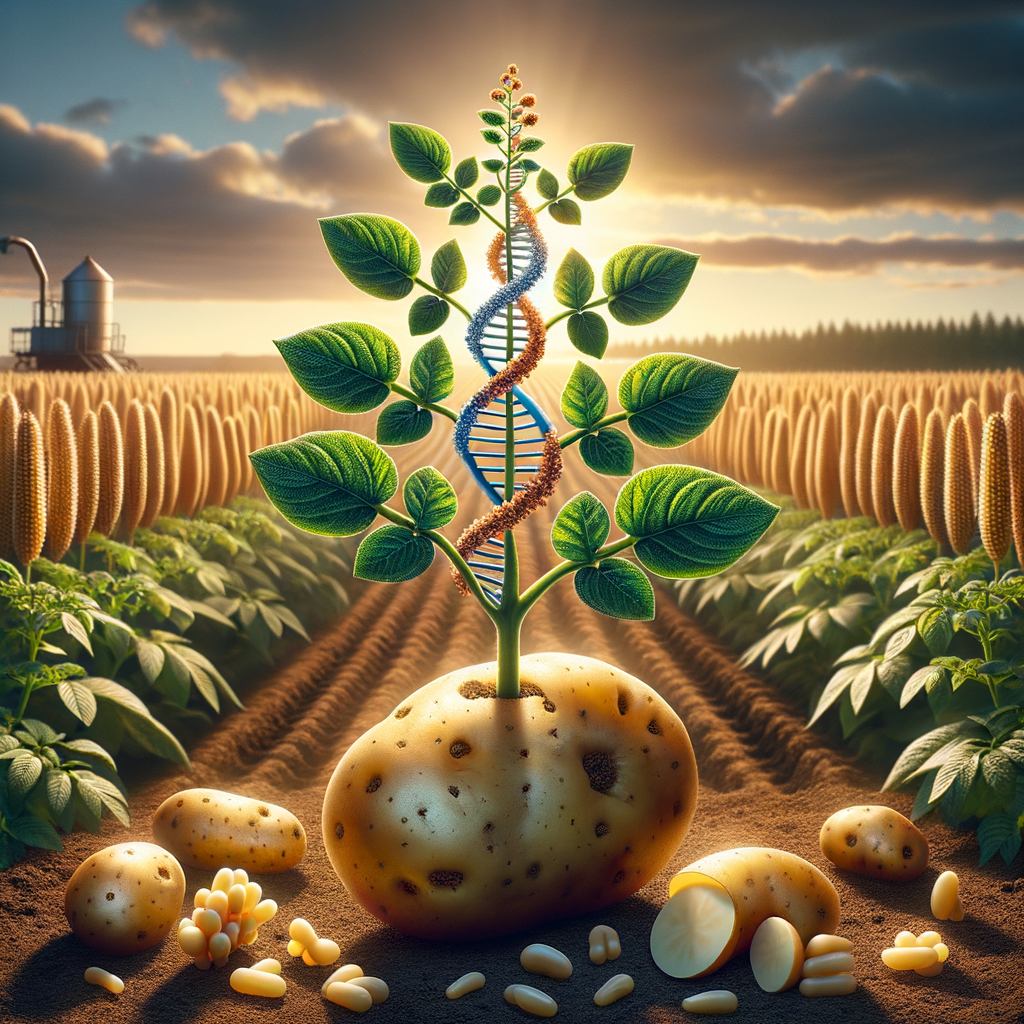
Potatoes are the world's third most important food crop, yet their breeding has been stuck in the past for centuries. A radical new approach using haploid breeding could transform how we grow this staple food - starting with the simple act of preventing the plant from flowering.
Listen to This Article
AI-generated discussion • ~8 min
Imagine you are a farmer. Every year, instead of planting tiny seeds like you would for wheat or rice, you haul around heavy bags of cut-up potato tubers - bulky, perishable, and prone to carrying diseases. This is how potatoes have been grown for centuries, and it is a system that is extraordinarily wasteful. But a team of researchers at the Chinese Academy of Agricultural Sciences has just published a breakthrough in Nature Plants that could change everything - by creating potato plants that cannot pollinate themselves, and in doing so, redirect all their energy into growing bigger, better tubers.
The paper, led by Dawei Li, Xinyu Jing, and corresponding author Chunzhi Zhang at the Agricultural Genomics Institute at Shenzhen, tackles one of the oldest problems in agriculture: how do you breed a better potato? The answer, it turns out, involves understanding why potatoes are so genetically complicated in the first place. Most crop plants are diploid - they carry two copies of each chromosome, one from each parent. But potatoes are tetraploid, meaning they carry four copies of every chromosome.
To understand why this matters, think of a library. A diploid organism is like a library with two copies of every book - easy to organize, easy to find what you need. A tetraploid organism is like a library with four copies of every book, where each copy might have slightly different typos, marginalia, and missing pages. Trying to breed for a specific trait in this jumbled four-copy system is astronomically more difficult. The number of possible genetic combinations explodes, making traditional breeding painfully slow and unpredictable.
The solution that researchers have been pursuing is to convert potatoes from tetraploid to diploid - essentially reorganizing that chaotic four-copy library into a clean two-copy system. This is done through a process called haploid induction. First, you create a haploid plant with just a single set of chromosomes, then double that set to create a perfectly homozygous diploid. Think of it as photocopying the one good edition of every book so you have two identical, error-free copies. The result is a genetically clean, predictable plant that breeders can work with.
But here is where this paper delivers its real innovation. Once you have these clean diploid potato lines, you can cross two different lines to create an F1 hybrid - and F1 hybrids benefit from hybrid vigor (heterosis). This is the same principle that revolutionized corn production decades ago. The offspring of two distinct parent lines are often stronger, more productive, and more resilient than either parent. The dream is to produce potato seeds - tiny, lightweight seeds that can be mailed in an envelope - instead of bulky tubers that must be shipped in refrigerated trucks.
The breakthrough in this study is the creation of self-incompatible homozygous diploid potato lines through haploid breeding. Self-incompatibility is like a lock that does not fit its own key. The plant produces pollen, but that pollen cannot fertilize the plant's own flowers. It is a natural mechanism found in many wild potato species, and the researchers harnessed it to solve a problem that has plagued potato breeders: sink competition.
Here is the key insight: every plant has a limited energy budget. It can spend that budget growing roots, leaves, stems, flowers, fruits, or tubers - but it cannot do everything at maximum capacity. When a potato plant successfully pollinates itself, it produces aerial berries (yes, potato plants make small, tomato-like fruits above ground). Growing those berries drains energy away from the tubers underground - the part we actually want to eat. This is sink competition in action: the berries and tubers are competing for the same pool of sugars and nutrients.
By making the plant self-incompatible, the researchers ensured that no aerial fruits form when the plant is grown in isolation or in a field of the same line. Without fruits draining the energy budget, all of the plant's resources flow downward into the tubers. The result is a dramatically improved harvest index - the percentage of the plant's total energy that ends up in the part we eat. A higher harvest index means more potato per plant, more food per acre, and more efficient farming.
But the benefits do not stop at bigger tubers. Self-incompatibility also solves a major practical problem for hybrid seed production. To create F1 hybrid seeds, you need to cross two different parent lines. If the parent plants can pollinate themselves, you end up with a mixture of self-pollinated seeds (which are not hybrids) and cross-pollinated seeds (which are). Sorting out the real hybrids from the self-pollinated impostors is expensive and labor-intensive. With self-incompatible parents, every seed produced in a crossing field is guaranteed to be a true hybrid, because self-pollination is biologically impossible. This makes large-scale, low-cost hybrid seed production feasible for the first time.
The implications are staggering. Instead of shipping tons of perishable, disease-carrying tubers across continents, farmers could receive a small packet of hybrid seeds. These seeds would be free from the soil-borne diseases that plague conventional seed potatoes, such as late blight (the disease that caused the Irish Potato Famine), bacterial wilt, and various viruses. They would cost a fraction of the price to transport. And because they are true F1 hybrids, they would exhibit heterosis, producing higher yields and better disease resistance than conventional varieties.
This work represents a pivotal step in transforming the potato from a vegetatively propagated relic of pre-scientific agriculture into a modern, seed-based crop. The combination of haploid induction to create clean diploid lines, self-incompatibility to eliminate sink competition and ensure hybrid purity, and F1 hybridization to harness heterosis creates a complete breeding pipeline that could do for potatoes what the Green Revolution did for wheat and rice half a century ago.
Real-World Impact
Quick Takeaways
- Self-incompatible diploid potatoes eliminate energy waste from aerial fruit production, channeling all resources into tuber growth and dramatically improving harvest index
- Hybrid potato seeds could replace bulky, disease-prone seed tubers, slashing transportation costs and eliminating soil-borne disease transmission
- Guaranteed hybrid purity from self-incompatible parent lines makes large-scale, low-cost commercial seed production feasible for the first time
- This breeding pipeline could bring Green Revolution-scale yield improvements to the world's third most important food crop, directly benefiting food security in developing nations
The food security implications of this research are profound. Potatoes are a critical staple food for over a billion people, and they are particularly important in developing nations across Africa, South Asia, and South America where they provide essential calories and nutrition. Currently, these regions face enormous challenges in accessing quality seed potatoes. The tubers must be stored in climate-controlled facilities, transported in refrigerated trucks, and planted within a narrow window before they spoil or sprout. In many parts of sub-Saharan Africa, farmers recycle their own tubers for years, accumulating diseases that progressively reduce yields. Hybrid seeds could bypass this entire problem - they are shelf-stable, lightweight, disease-free, and can be distributed through the same channels that already deliver rice and vegetable seeds to smallholder farmers worldwide.
From an agricultural economics perspective, the shift from vegetative propagation to hybrid seeds could restructure the entire potato industry. The global seed potato market is worth billions of dollars, but the logistics are staggeringly inefficient. Transporting seed tubers accounts for up to 50 percent of total production costs in some regions. Seed certification programs, which test tubers for diseases, are expensive and limited in reach. A transition to hybrid seeds would collapse these logistical chains, dramatically reduce costs, and open potato farming to regions where it was previously impractical due to the expense and difficulty of obtaining quality seed tubers. Furthermore, the ability to breed potatoes with the same precision and speed as corn or tomatoes would accelerate the development of varieties tailored to local conditions, pest pressures, and consumer preferences.
Climate resilience is perhaps the most urgent dimension of this breakthrough. As global temperatures rise, traditional potato-growing regions are facing increasingly unpredictable weather, shifting pest ranges, and water scarcity. Conventional potato breeding takes 10 to 15 years to develop a new variety - far too slow to keep pace with climate change. The diploid hybrid system described in this paper could compress that timeline to just a few years by enabling the rapid combination of traits from different parent lines: drought tolerance from one parent, heat resistance from another, disease resistance from a third. The ability to quickly stack beneficial traits through hybridization, rather than laboriously selecting through tetraploid crosses, gives breeders a powerful new tool for developing climate-adapted potato varieties before it is too late.
For Researchers & Scientists - Technical Section
This study by Li, Jing, Zhang et al. at the Agricultural Genomics Institute at Shenzhen (Chinese Academy of Agricultural Sciences) demonstrates the production of self-incompatible homozygous diploid potato lines through haploid induction, published in Nature Plants (February 2026). The work addresses a fundamental constraint in the reinvention of potato as a diploid hybrid crop: the elimination of self-fertility to simultaneously improve harvest index through suppression of aerial berry formation and ensure hybrid seed purity in commercial crossing programs. The approach leverages the natural S-locus-based gametophytic self-incompatibility system present in wild Solanum species, restoring it in cultivated germplasm through targeted haploid breeding strategies.
Methodology & Approach
Methodology & Approach
The researchers employed a multi-step haploid breeding pipeline beginning with the induction of haploid plants from tetraploid cultivated potato (Solanum tuberosum) using pollination with haploid inducer lines. Haploid offspring were screened for ploidy level using flow cytometry and chromosome counting. Selected haploid plants underwent spontaneous or colchicine-induced chromosome doubling to generate homozygous diploid lines. These doubled haploids were genotyped at the S-locus to identify lines carrying functional self-incompatibility alleles. Self-incompatibility was confirmed through controlled pollination assays, pollen tube growth visualization using fluorescence microscopy, and fruit set monitoring. Harvest index was quantified by measuring total above-ground and below-ground biomass partitioning across self-compatible and self-incompatible lines grown under identical field conditions. Hybrid seed production was evaluated by crossing self-incompatible lines with compatible diploid pollinators and assessing seed set, germination rates, and F1 hybrid performance.
Key Techniques & Methods
- Haploid induction via pollination with inducer lines: Generation of monoploid (1n) plants from tetraploid cultivated potato, followed by chromosome doubling to produce homozygous diploid (2n) lines with fixed genotypes
- Flow cytometry and karyotyping: Precise determination of ploidy level in induced offspring to identify true haploids and confirm successful chromosome doubling events
- S-locus genotyping and self-incompatibility screening: Molecular characterization of self-incompatibility alleles using PCR-based markers to identify lines carrying functional S-RNase and SLF genes
- Fluorescence microscopy pollen tube assays: Visualization of pollen tube growth in styles following self- and cross-pollination to confirm functional self-incompatibility at the cellular level
- Harvest index phenotyping: Quantitative measurement of biomass partitioning between tubers, aerial berries, and vegetative tissue under controlled field conditions to assess the agronomic impact of self-incompatibility on tuber yield
Key Findings & Results
- Haploid induction from tetraploid potato successfully yielded monoploid plants that, upon chromosome doubling, produced homozygous diploid lines with stable self-incompatibility phenotypes confirmed across multiple generations
- Self-incompatible lines showed complete suppression of aerial berry formation under field conditions, eliminating reproductive sink competition and redirecting photosynthate allocation toward tuber development
- Harvest index in self-incompatible lines was significantly higher than in self-compatible controls, with a measurable increase in tuber biomass as a proportion of total plant dry weight
- Crossing self-incompatible lines with compatible diploid pollinators produced high seed set with near-100% hybrid purity, as confirmed by molecular marker analysis of F1 offspring
- F1 hybrid progeny from self-incompatible parents exhibited heterosis for tuber yield, uniformity, and vigor, demonstrating the practical viability of the hybrid breeding pipeline
- The self-incompatibility trait was stably inherited in doubled haploid lines and could be maintained through vegetative propagation of parental stocks, enabling reproducible hybrid seed production across growing seasons
Conclusions
This study establishes a complete and practical pathway for converting potato from a clonally propagated tetraploid crop into a diploid hybrid seed crop. The key innovation is the integration of self-incompatibility into the homozygous diploid breeding framework, which simultaneously addresses two critical bottlenecks: the agronomic penalty of aerial berry formation (sink competition) and the commercial challenge of ensuring hybrid seed purity without manual emasculation or chemical gametocides. The demonstrated improvement in harvest index confirms the physiological hypothesis that reproductive sink removal enhances tuber productivity, while the near-perfect hybrid purity in crossing programs validates the commercial feasibility of the approach. These results, combined with the inherent advantages of true seed (disease-free propagation, reduced logistics costs, and long shelf life), position diploid hybrid potato breeding as a transformative technology for global food security. Future work should focus on expanding the diversity of self-incompatible doubled haploid lines, optimizing hybrid combinations for regional adaptation, and developing agronomic protocols for transplanting or direct seeding of hybrid potato seed under field conditions.
-- readers