Water's Hidden Role: How Interface Engineering Could Transform Green Energy
For decades, scientists have focused on perfecting the metal surfaces that split water into hydrogen and oxygen. Now, groundbreaking research reveals that the water molecules themselves are equally important players in this crucial clean energy reaction.
Listen to This Article
AI-generated discussion • ~6 min
Imagine trying to organize a flash mob where dancers must coordinate perfectly, but you've been focusing only on the stage while ignoring how the crowd arranges itself around the performance area. For decades, that's essentially what scientists have been doing with oxygen evolution reaction (OER) research, the critical process that determines how efficiently we can produce clean hydrogen fuel.
A revolutionary study published in Nature Chemistry has fundamentally rewritten our understanding of this crucial reaction. Led by Rebecca K. Pittkowski and colleagues, the research demonstrates that water molecules aren't just passive participants in the splitting process. Instead, how these molecules organize themselves at the boundary between the electrode and the surrounding liquid plays a starring role in determining reaction efficiency.
The implications are profound. Current catalyst design paradigms have focused almost exclusively on engineering the metal surface itself, following what's known as the volcano plot approach. Think of it like trying to improve a restaurant by only focusing on the kitchen equipment while completely ignoring how customers flow through the dining room.
To uncover this hidden layer of complexity, the researchers employed a sophisticated combination of operando characterization techniques. Using temperature-dependent electrochemistry alongside real-time X-ray analysis, they could observe both the catalyst surface and the water molecules simultaneously as the reaction proceeded. It's like having a high-speed camera that can capture both the dancers and the crowd dynamics during that flash mob performance.
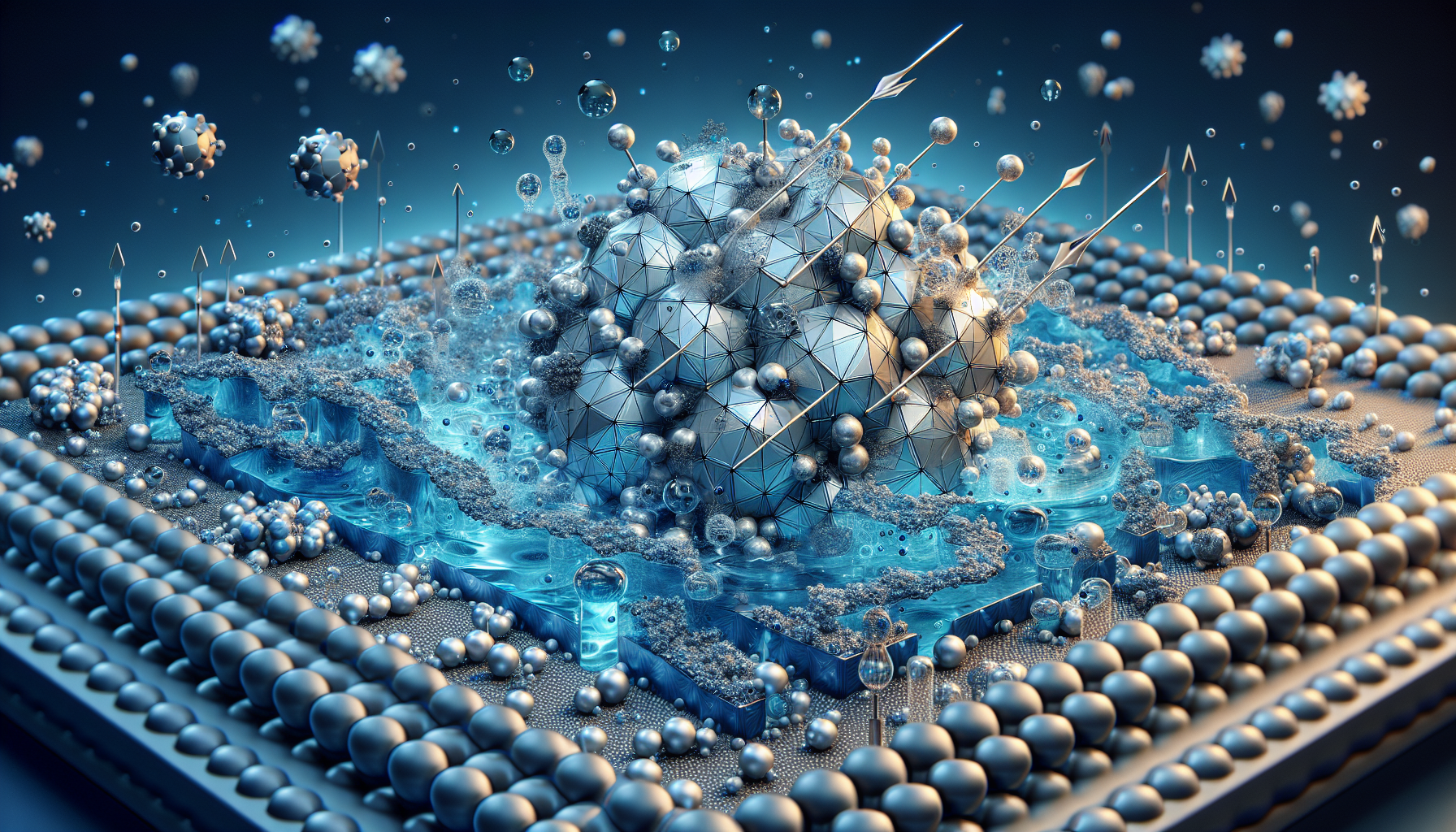
The breakthrough came from observing what happens at the electrode-electrolyte interface, the crucial boundary where the solid electrode meets the liquid solution. Previous research had largely treated this interface as a simple meeting point, but the new findings reveal it as a dynamic, structured region where water molecules arrange themselves in specific patterns that either help or hinder the oxygen evolution process.
The research team discovered that interfacial water ordering occurs simultaneously with catalyst surface restructuring during the reaction. These two processes work together like dance partners, with changes in one immediately affecting the other. When water molecules organize favorably at the interface, they create pathways that make it easier for oxygen to form and escape. When the organization is poor, even an excellent catalyst struggles to perform efficiently.
This discovery opens an entirely new dimension for improving electrolyzers and fuel cells, both critical technologies for storing and utilizing clean energy. Instead of focusing solely on finding better catalyst materials, researchers can now engineer the electrode-electrolyte interface to promote favorable water molecule arrangements.
The practical implications extend far beyond academic interest. More efficient water splitting directly translates to cheaper green hydrogen production, potentially accelerating the adoption of hydrogen as a clean fuel for everything from industrial processes to transportation. As governments worldwide invest billions in hydrogen infrastructure, improvements in electrolyzer efficiency could significantly impact the economics of the entire clean energy transition.
Perhaps most importantly, this research demonstrates how interdisciplinary approaches can reveal hidden aspects of well-studied systems. By combining electrochemistry with advanced X-ray techniques and focusing on the often-overlooked interface region, the team uncovered a fundamental aspect of catalysis that had been hiding in plain sight for decades.
Real-World Impact
Quick Takeaways
- Could significantly improve efficiency of electrolyzers used for green hydrogen production
- Opens new research direction focusing on electrode-electrolyte interface engineering
- May reduce costs of clean hydrogen fuel, accelerating adoption in transportation and industry
- Provides framework for designing better fuel cells and energy storage systems
- Challenges current catalyst design paradigms, potentially leading to breakthrough materials
This breakthrough fundamentally changes how researchers approach electrocatalyst design for clean energy applications. Rather than focusing exclusively on catalyst surface properties, the field can now pursue dual optimization of both the electrode material and the interfacial water structure. This could lead to dramatic efficiency improvements in commercial electrolyzers, potentially reducing the cost of green hydrogen production by optimizing previously overlooked interface phenomena.
The implications extend throughout the hydrogen economy, from large-scale industrial hydrogen production facilities to fuel cell vehicles. More efficient water splitting means lower electricity requirements for hydrogen generation, directly improving the economics of hydrogen as a clean fuel alternative. Additionally, the principles discovered here may apply to other electrochemical energy systems, including batteries and fuel cells, opening multiple avenues for clean energy technology advancement.
Beyond immediate technological applications, this research establishes a new paradigm for electrochemical interface engineering. The methodology combining operando characterization with temperature-dependent studies provides a template for investigating other complex electrochemical systems where interface phenomena may play crucial but underappreciated roles in determining performance.
For Researchers & Scientists - Technical Section
The research employed temperature-dependent electrochemistry coupled with operando X-ray characterization to investigate the electrode-electrolyte interface during oxygen evolution reaction conditions. This approach enabled real-time observation of both catalyst surface restructuring and interfacial water molecule reorganization, revealing their coupled influence on OER kinetics and challenging the prevailing catalyst-centric design paradigm.
Methodology & Approach
Methodology & Approach
The study utilized a sophisticated combination of temperature-dependent electrochemical measurements and operando X-ray characterization techniques to probe the electrode-electrolyte interface during active oxygen evolution conditions. This approach allowed simultaneous monitoring of catalyst surface changes and interfacial water structure evolution in real-time, providing unprecedented insight into the coupled dynamics governing OER kinetics.
The researchers employed systematic temperature variations to manipulate interfacial water ordering while using advanced X-ray techniques to characterize both the catalyst surface restructuring and the organization of water molecules at the electrode-electrolyte boundary. This methodology enabled direct correlation between interfacial water structure and catalytic performance, revealing the critical role of solvent organization in electrochemical energy conversion processes.
Key Techniques & Methods
- Temperature-dependent electrochemistry: Systematic variation of reaction temperature to probe interfacial water ordering effects
- Operando X-ray characterization: Real-time X-ray analysis during active oxygen evolution reaction conditions
- Electrode-electrolyte interface analysis: Detailed characterization of the boundary region between solid electrode and liquid electrolyte
- Catalyst surface restructuring monitoring: Tracking changes in catalyst surface structure during reaction conditions
- Interfacial water structure determination: Characterization of water molecule organization at electrode interfaces
- Coupled kinetics analysis: Simultaneous measurement of catalytic performance and interface structure changes
Key Findings & Results
- Catalytic activity is not governed solely by intrinsic catalyst surface properties as previously assumed
- Interfacial water molecule ordering at the electrode-electrolyte boundary critically influences OER kinetics
- Two catalysts with identical surface chemistry can exhibit dramatically different activities based on water interactions
- Catalyst surface restructuring and water molecule reorganization occur simultaneously during the reaction
- The electrode-electrolyte interface represents a previously underappreciated dimension for catalyst optimization
- Real-time operando measurements revealed coupled dynamics between catalyst and solvent structure
Conclusions
The study establishes that oxygen evolution reaction kinetics are governed by coupled catalyst-solvent interactions at the electrode-electrolyte interface, not solely by catalyst surface properties. This discovery necessitates a paradigm shift from purely catalyst-centric design approaches toward integrated interface engineering strategies that optimize both electrode materials and interfacial water structure for enhanced electrochemical energy conversion efficiency.
-- readers