Frieze Patterns Unlock New Quantum Secrets: Exotic Charge Stripes Found in Superconductor
Scientists have discovered patterns in quantum materials that follow the same mathematical rules as ancient decorative friezes found on Greek temples. These exotic charge arrangements could revolutionize our understanding of superconductivity.
Listen to This Article
AI-generated discussion • ~6 min
Imagine electrons dancing in patterns so exotic they mirror the decorative friezes adorning ancient temples. That's exactly what scientists at leading research institutions have discovered in a cutting-edge quantum material called a kagome superconductor. Their findings, published in Nature Physics, reveal a previously unknown type of electronic organization that could unlock new frontiers in quantum technology.
The research team used an ultra-precise technique called spectroscopic imaging scanning tunnelling microscopy to peer into the atomic world of CsCr3Sb5, a material with a unique crystal structure. What they found defied conventional wisdom about how electrons organize themselves in quantum materials.
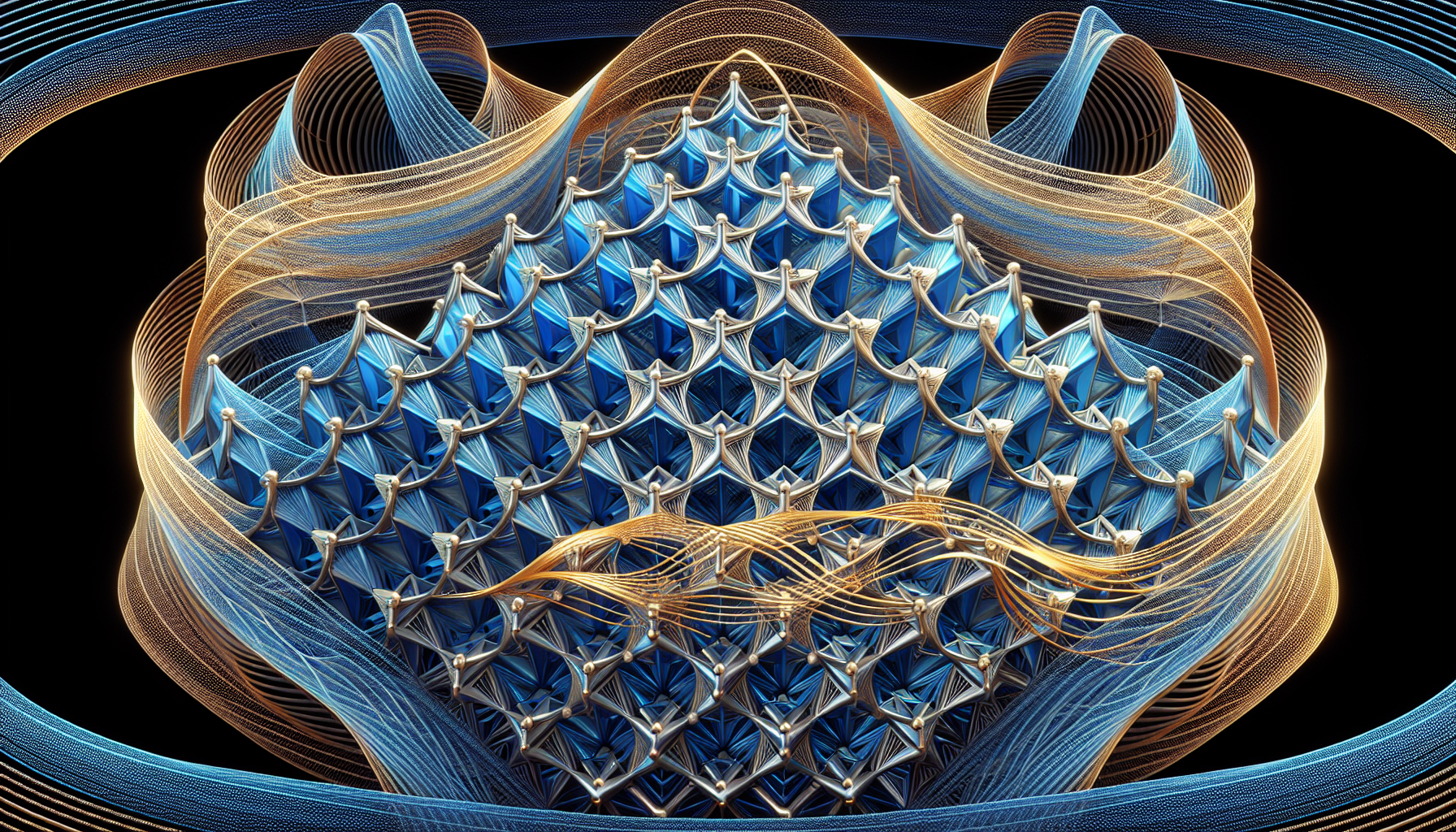
At the heart of this discovery lies the kagome lattice, a geometric arrangement that looks like a Japanese basket weave. Think of it as a honeycomb pattern where triangles replace hexagons. This seemingly simple change creates what physicists call geometric frustration, like trying to arrange magnets on triangle corners where each wants to point away from its neighbors, but geometry makes this impossible.
The researchers discovered something extraordinary: electrons in this frustrated lattice don't just give up and settle randomly. Instead, they form highly organized patterns called charge density waves. These waves are like traffic jams of electrons that move in coordinated patterns, similar to how cars might organize into moving lanes during rush hour.
The breakthrough came when the team identified what they termed frieze charge stripe order. This phase exhibits chiral textures, meaning the electron patterns have a distinct handedness, like the difference between your left and right hands. Remarkably, these patterns follow the mathematical rules of frieze groups, the same seven fundamental symmetry patterns that describe decorative borders and architectural friezes.
What makes this discovery particularly intriguing is how these charge stripes break mirror symmetries. Imagine looking at your reflection in a broken mirror where some pieces are missing, yet certain aspects of your image remain intact. The frieze charge stripes break most mirror symmetries but preserve what's called mirror glide symmetry, creating a unidirectional pattern that flows like a river with internal structure.
The team observed a cascade of density-wave transitions, each with distinct symmetry properties. Think of it like water transforming through different phases, but instead of ice, liquid, and vapor, electrons organize into different collective states with unique geometric signatures. This cascade reveals the rich physics hidden within the kagome geometry.
These findings provide critical experimental evidence about symmetry breaking in kagome metals. The research demonstrates how the inherent sublattice degrees of freedom in kagome lattices govern exotic electronic phases. It's like discovering that a simple weaving pattern can create complex, three-dimensional sculptures when electrons become the threads.
The significance of this work extends far beyond academic curiosity. Understanding how charge density waves intertwine with superconductivity in kagome metals represents a central frontier in condensed matter physics. These exotic electronic orders could lead to novel superconducting states with properties we've never seen before.
The interplay between geometric frustration, charge order, and chirality opens new pathways for designing quantum materials with tailored properties. Future technologies might harness these frieze-patterned electron states to create more efficient superconductors, novel quantum sensors, or even building blocks for quantum computers. The marriage of ancient mathematical symmetries with cutting-edge quantum physics reminds us that nature's most sophisticated designs often echo the patterns humans have long found beautiful and meaningful.
Real-World Impact
Quick Takeaways
- Could enable design of more efficient superconductors for power transmission and magnetic levitation systems
- May lead to novel quantum sensors with unprecedented sensitivity for medical imaging and navigation
- Potential applications in quantum computing architectures using exotic electronic states
- Opens pathways for creating materials with tailored electronic properties for next-generation electronics
- Advances fundamental understanding needed for room-temperature superconductors
The discovery of frieze charge stripe patterns in kagome superconductors could revolutionize multiple technological domains. In energy applications, understanding these exotic electronic phases may accelerate the development of more efficient superconducting materials for power grids, reducing energy losses during electrical transmission. The unique interplay between charge order and superconductivity could also lead to breakthroughs in magnetic levitation systems for transportation.
In the realm of quantum technologies, these findings open new possibilities for quantum sensing and computing. The chiral nature of the charge patterns could be harnessed to create quantum sensors with enhanced sensitivity, potentially improving medical imaging techniques like MRI or enabling more precise navigation systems. Additionally, the exotic electronic states discovered in kagome materials might serve as novel platforms for quantum information processing, offering new approaches to building stable quantum computers.
From a materials science perspective, this research provides crucial insights into how geometric frustration can be engineered to create materials with desired properties. Future electronics could benefit from materials designed using these principles, potentially leading to devices with unprecedented performance characteristics. The fundamental understanding gained about symmetry breaking in quantum materials also brings us closer to the holy grail of condensed matter physics: room-temperature superconductors that could transform everything from medical devices to space exploration.
For Researchers & Scientists - Technical Section
The research team employed spectroscopic imaging scanning tunnelling microscopy (SI-STM) to investigate charge-ordered phases in bulk single crystals of the kagome superconductor CsCr3Sb5. Through systematic spectroscopic mapping, they identified a cascade of density-wave transitions characterized by distinct symmetry properties. The methodology enabled atomic-scale visualization of electronic states and revealed the emergence of unidirectional density waves that break conventional mirror symmetries while preserving mirror glide symmetry, corresponding to frieze group mathematical classifications.
Methodology & Approach
Methodology & Approach
The experimental approach centered on spectroscopic imaging scanning tunnelling microscopy (SI-STM) performed on high-quality bulk single crystals of CsCr3Sb5. The technique provided atomic-resolution mapping of electronic density of states, enabling direct visualization of charge density wave formation and symmetry properties. Temperature-dependent measurements allowed characterization of the phase transition cascade.
Data analysis involved systematic symmetry classification using mathematical frieze group theory to identify the unique unidirectional charge ordering patterns. The team correlated spectroscopic signatures with crystallographic structure analysis to understand how sublattice degrees of freedom inherent to the kagome geometry influence electronic phase formation. Comparative analysis across different temperature regimes revealed the relationship between geometric frustration and exotic charge ordering phenomena.
Key Techniques & Methods
- Spectroscopic Imaging Scanning Tunnelling Microscopy (SI-STM): Atomic-scale mapping of electronic properties using quantum tunneling effects
- Bulk Single Crystal Growth: Synthesis of high-purity crystalline samples for precise electronic measurements
- Temperature-Dependent Electronic Spectroscopy: Characterization of phase transitions across different thermal conditions
- Frieze Group Symmetry Analysis: Mathematical classification of charge pattern symmetries using group theory
- Density Wave Pattern Recognition: Identification and analysis of periodic charge modulations in electronic systems
- Crystallographic Structure Correlation: Linking electronic properties to underlying atomic lattice arrangements
Key Findings & Results
- Discovery of frieze charge stripe order phase with unique symmetry properties in CsCr3Sb5 kagome superconductor
- Identification of cascade of density-wave transitions with distinct symmetry characteristics
- Observation of unidirectional density waves that break all mirror symmetries while retaining mirror glide symmetry
- Demonstration that sublattice degrees of freedom in kagome lattices govern exotic electronic phase formation
- Evidence of chiral textures in charge patterns corresponding to fundamental frieze symmetry groups
- Experimental proof of geometric frustration effects creating intertwined charge order and chirality phenomena
Conclusions
The study establishes that geometric frustration inherent to kagome lattice structures enables the formation of previously unobserved electronic phases with exotic symmetry properties. The frieze charge stripe order represents a new class of density wave states that bridge conventional charge ordering and topological electronic phases. These findings provide fundamental insights into symmetry breaking mechanisms in frustrated quantum materials and demonstrate how lattice geometry can be leveraged to engineer novel electronic states with potential applications in quantum technologies and advanced superconducting systems.
-- readers