Plastic to Fuel Revolution: Sunlight Transforms Waste into Hydrogen
What if the plastic water bottle you just finished could power your car tomorrow? Cambridge scientists have cracked the code to turn stubborn plastic waste into clean hydrogen fuel using nothing but sunlight and old car battery acid.
Listen to This Article
AI-generated discussion • ~8 min
Imagine if every discarded plastic bottle, worn-out sneaker, and old foam cushion could be transformed into clean fuel using nothing more than sunlight. This isn't science fiction anymore. Researchers at the University of Cambridge have developed a revolutionary system that converts our most stubborn plastic waste into hydrogen fuel, using an unlikely helper: the acid from old car batteries.
The global plastic crisis has reached staggering proportions. We produce over 300 million tons of plastic waste annually, with much of it ending up in landfills or incinerators because it's simply too difficult to recycle. Meanwhile, spent lead-acid car batteries generate millions of gallons of sulfuric acid waste that poses its own environmental hazard. What if these two waste streams could solve each other's problems?
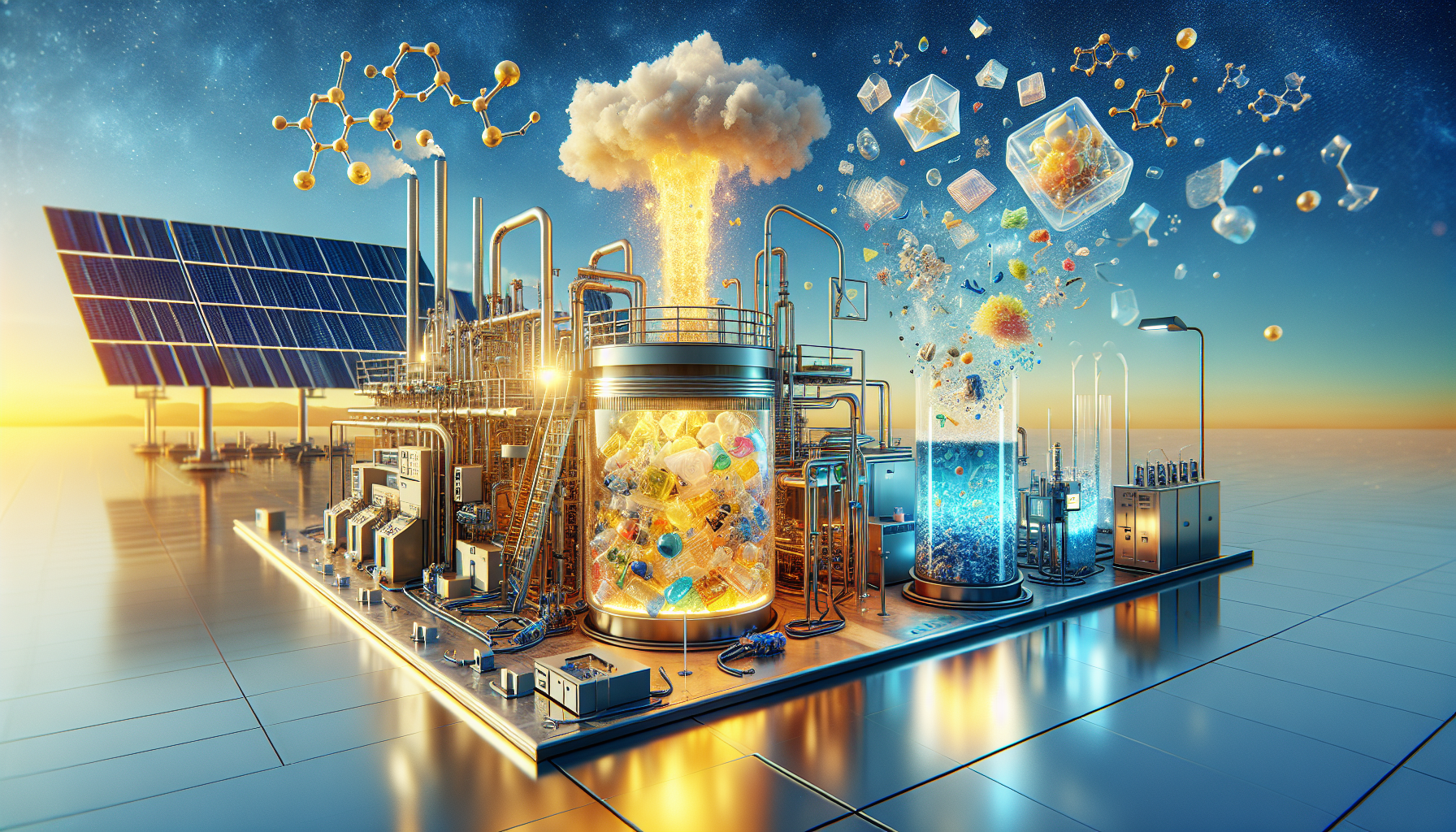
The Cambridge team, led by Professor Erwin Reisner, has created something unprecedented: a photocatalytic system that tackles both problems simultaneously. Think of it as a molecular-scale recycling plant powered entirely by the sun, where plastic molecules are carefully disassembled and rebuilt into valuable products.
The heart of this innovation lies in a specially designed catalyst. Traditional catalysts would dissolve in the harsh acidic conditions needed to break down plastics, like sugar dissolving in coffee. But this new catalyst, called CoMoS2-CNx, is built to withstand acid like a submarine built for deep-sea exploration.
Here's how the magic happens: When sunlight hits the catalyst, it energizes electrons like a solar panel charging a battery. These energized electrons then help break the strong chemical bonds holding plastic molecules together, a process called depolymerisation. It's like using solar-powered molecular scissors to cut a long chain into useful links. The sulfuric acid acts as a chemical assistant, helping to snip these molecular chains more efficiently.
The results are impressive by any measure. Under standard solar conditions, PET plastic bottles yield 0.35 millimoles of hydrogen per gram, while under optimized LED lighting, this jumps to 1.9 millimoles per gram. To put this in perspective, it's like getting multiple servings of fuel from a single serving of waste. Even more exciting, different plastics perform differently: nylon fabrics produce 1.0 millimoles of hydrogen per gram over 24 hours, while polyurethane foam generates an outstanding 4.2 millimoles per gram.
But hydrogen isn't the only prize. The process also produces valuable organic monomers, the chemical building blocks that can be used to make new plastics or other industrial chemicals. It's like demolishing a building and ending up with both energy and perfectly good bricks for construction.
What makes this research particularly significant is its focus on hard-to-recycle plastics, the ones that typically end up in landfills because conventional recycling can't handle them. These include everything from multilayer food packaging to old running shoes. The system works with real post-consumer waste, complete with dirt, labels, and other contaminants that would stymie traditional recycling methods.
The implications extend far beyond the laboratory. This technology offers a pathway to simultaneously address the plastic waste crisis and produce clean hydrogen fuel for our energy needs. Unlike current hydrogen production methods that often rely on fossil fuels, this approach is entirely solar-powered and carbon-neutral. It transforms environmental problems into environmental solutions, creating a true circular economy where waste becomes resource.
As the world grapples with both pollution and the need for clean energy, innovations like this solar reforming system point toward a future where our waste streams become our fuel streams, powered by the most abundant energy source of all: sunlight.
Real-World Impact
Quick Takeaways
- Addresses global plastic waste crisis by processing hard-to-recycle materials currently sent to landfills
- Produces clean hydrogen fuel without fossil fuel inputs, advancing renewable energy goals
- Repurposes hazardous sulfuric acid waste from car batteries into useful industrial reagent
- Creates valuable chemical building blocks alongside hydrogen for circular economy applications
- Offers scalable, low-cost technology that works with real-world contaminated plastic waste
This breakthrough technology addresses multiple environmental crises simultaneously, creating a powerful example of circular economy principles in action. By targeting hard-to-recycle plastics that currently overwhelm landfills and pollute ecosystems, the system offers a practical solution to one of our most pressing waste management challenges. The ability to process real-world contaminated plastic waste, rather than just laboratory-grade samples, makes this approach immediately relevant for large-scale implementation.
The production of clean hydrogen fuel represents a significant advancement in renewable energy technology. Unlike conventional hydrogen production methods that often rely on fossil fuels and generate carbon emissions, this solar-powered approach is entirely carbon-neutral. The hydrogen produced can power fuel cells for vehicles, provide energy storage for renewable power grids, or serve as a clean industrial fuel, directly supporting global decarbonization efforts.
Perhaps most importantly, the integration of sulfuric acid waste from spent car batteries transforms a hazardous disposal problem into a valuable resource. This creates multiple waste-to-resource pathways within a single process, demonstrating how innovative chemistry can turn environmental liabilities into economic and environmental assets. The scalable nature of the technology, combined with its reliance on abundant sunlight, positions it as a viable solution for both developed and developing nations struggling with plastic waste management.
For Researchers & Scientists - Technical Section
The research team developed an acid-stable photocatalyst system integrating cyanamide-functionalized carbon nitride with cobalt-promoted molybdenum disulfide (CoMoS2-CNx) to enable simultaneous acid-catalyzed depolymerization and visible-light photoreforming of plastic waste. The system utilizes sulfuric acid recovered from spent lead-acid batteries as both solvent and depolymerization agent, while the photocatalyst harvests solar energy to drive hydrogen evolution and plastic breakdown under standard AM 1.5G irradiation conditions.
Methodology & Approach
Methodology & Approach
The research team designed a dual-function photocatalytic system that integrates acid-catalyzed depolymerization with visible-light-driven photoreforming. The core innovation involves a specially engineered acid-stable photocatalyst comprising cyanamide-functionalized carbon nitride integrated with cobalt-promoted molybdenum disulfide (CoMoS2-CNx). This catalyst maintains structural integrity and catalytic activity under the harsh acidic conditions required for plastic depolymerization.
The experimental setup utilized sulfuric acid recovered from spent lead-acid car batteries as the reaction medium, creating a closed-loop system that repurposes two waste streams. Plastic samples, including both laboratory-grade and real post-consumer waste, were subjected to the photocatalytic process under controlled illumination conditions ranging from standard AM 1.5G solar simulation to optimized 405 nm LED irradiation. The team systematically evaluated hydrogen production rates, organic monomer recovery, and catalyst stability across multiple plastic types including PET, nylon 66, and polyurethane over extended reaction periods up to 24 hours.
Key Techniques & Methods
- Acid-catalyzed depolymerization: Chemical breakdown of plastic polymers using sulfuric acid to cleave molecular bonds
- Visible-light photocatalysis: Light-driven catalytic process using solar energy to activate chemical reactions
- Cyanamide functionalization: Chemical modification technique to enhance catalyst stability in acidic conditions
- Solar irradiation testing: Standardized AM 1.5G and LED illumination protocols to evaluate photocatalytic performance
- Gas chromatography analysis: Quantitative measurement of hydrogen production and organic monomer yields
- Post-consumer waste processing: Real-world application testing with contaminated plastic waste materials
Key Findings & Results
- PET plastic yields 0.35 mmol H2 per gram under standard solar irradiation and 1.9 mmol H2 per gram under 405 nm LED
- Nylon 66 textiles produce 1.0 mmol H2 per gram over 24-hour processing periods
- Polyurethane foam generates 4.2 mmol H2 per gram, the highest yield among tested materials
- System successfully processes real post-consumer plastic waste with contaminants, not just laboratory samples
- Valuable organic monomers are recovered alongside hydrogen production for circular economy applications
- CoMoS2-CNx catalyst maintains stability and activity under harsh acidic depolymerization conditions
Conclusions
The integration of acid-catalyzed depolymerization with solar-driven photoreforming represents a paradigm shift in plastic waste valorization, demonstrating that hard-to-recycle polymers can be efficiently converted to valuable products using renewable energy inputs. The acid-stable CoMoS2-CNx photocatalyst overcomes traditional limitations of photocatalytic systems in acidic environments, enabling simultaneous waste stream processing that transforms both plastic waste and spent battery acid into useful resources. This approach offers a scalable, economically viable pathway for addressing the global plastic waste crisis while contributing to clean hydrogen production goals.
-- readers