The Ultimate Frictionless Flow: Scientists Finally Measure Superfluidity in 2D
Imagine a liquid that flows without any friction whatsoever, defying everything we know about fluid behavior. For the first time ever, scientists have measured exactly how much of a 2D quantum fluid exhibits this impossible property.
Listen to This Article
AI-generated discussion • ~6 min
Picture honey flowing through a straw. No matter how hard you try, friction always slows it down, creating resistance and generating heat. Now imagine a liquid so strange that it flows through the tiniest channels with absolutely zero friction, never losing energy, never slowing down. This isn't science fiction , it's superfluidity, one of nature's most bizarre quantum phenomena.
For decades, scientists have studied superfluids in three-dimensional systems, but measuring superfluidity in two-dimensional (2D) systems remained an elusive goal. Until now. A team of French physicists has achieved the first-ever direct measurement of the superfluid fraction in a 2D quantum system, opening new doors to understanding some of the universe's most exotic states of matter.
The challenge with 2D superfluids lies in their fundamental differences from their 3D cousins. Think of the difference between a soap bubble (2D surface) and a balloon filled with air (3D volume). The physics governing these systems are dramatically different, and 2D superfluids exhibit unique behaviors related to the famous Berezinskii-Kosterlitz-Thouless transition.
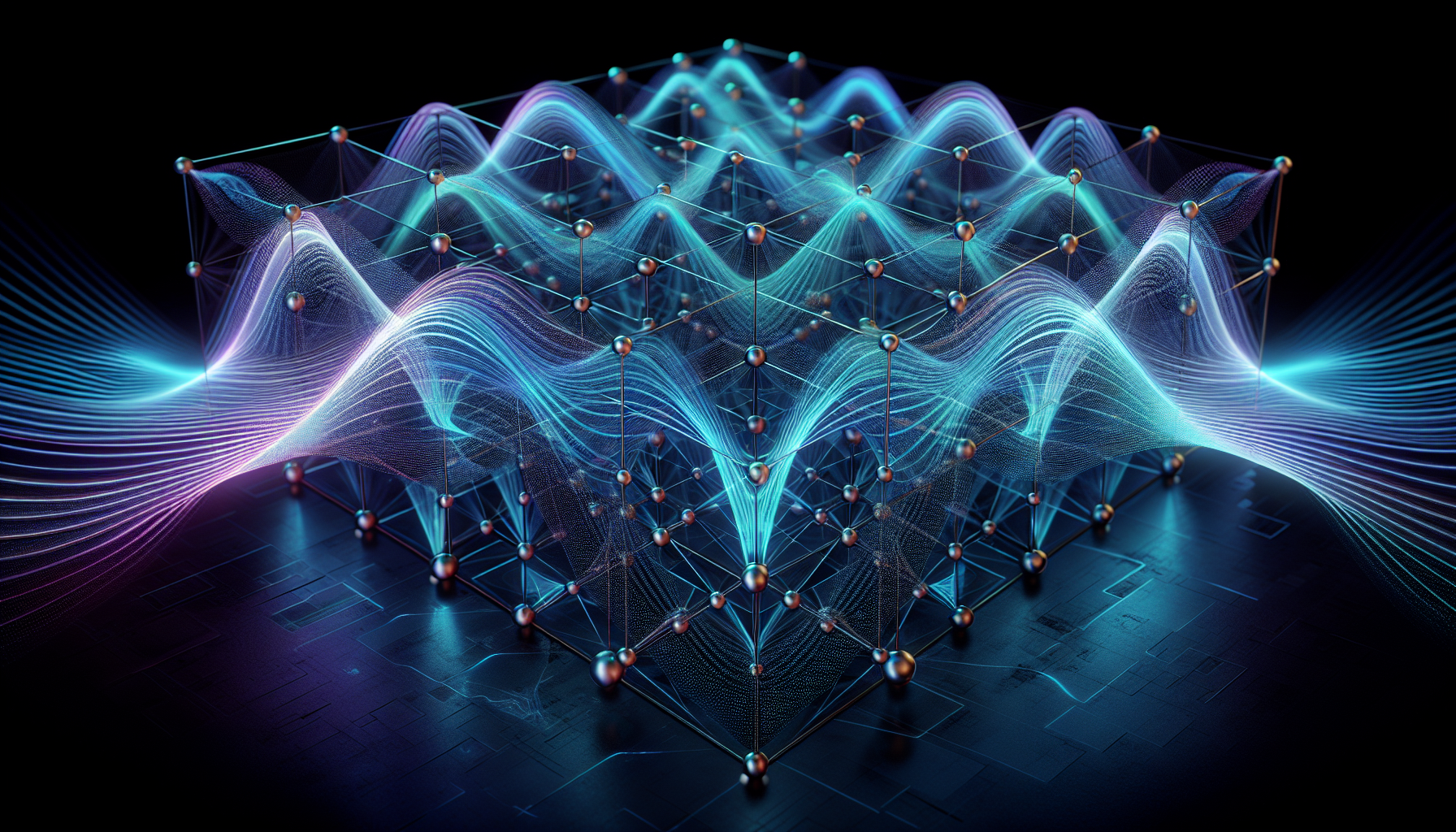
The research team, led by scientists at Laboratoire Kastler Brossel in Paris, tackled this challenge by creating an artificial 2D superfluid using ultracold atoms trapped in a triangular optical lattice. Imagine arranging atoms in a pattern like eggs in a triangular egg crate, but instead of cardboard, the crate is made of intersecting laser beams.
The experimental breakthrough required developing an entirely new measurement technique. The key insight was to use the hydrodynamic continuity equation, which is like a mathematical recipe that describes how fluids flow. By carefully measuring how the density of their atomic gas changed in real-time and in different locations, the researchers could extract the superfluid fraction with unprecedented precision.
To ensure their results were rock-solid, the team developed a second, completely independent method. This approach combined measurements of the gas's compressibility (how easily it can be squeezed) with its sound velocity (how fast sound travels through it). Think of it like checking your math problem using two different methods , if both give the same answer, you can be confident it's correct.
The results revealed fascinating physics. As the researchers made their triangular lattice deeper (stronger laser intensity), the superfluid fraction decreased. It's like the difference between marbles rolling freely on a flat table versus marbles trapped in increasingly deep dimples , the deeper the dimples, the less freely they can flow. The measurements perfectly matched theoretical predictions for weakly interacting 2D quantum gases, validating decades of theoretical work.
Perhaps most importantly, this research provides a powerful new tool for exploring exotic quantum states. The ability to precisely measure superfluid fractions in 2D systems opens pathways to studying quantum phases of matter that could be relevant to quantum computing and quantum simulation.
The broader implications extend far beyond academic curiosity. Understanding superfluidity in 2D systems could lead to new materials with unprecedented properties, advances in quantum technologies, and deeper insights into the fundamental nature of quantum matter. The research represents a landmark achievement in experimental quantum physics, finally bringing direct measurement capabilities to one of the most theoretically rich but experimentally challenging areas of condensed matter physics.
Real-World Impact
Quick Takeaways
- Enables direct study of 2D superfluidity, previously only accessible through theoretical models
- Provides new experimental tool applicable to other 2D quantum systems and exotic phases of matter
- Could accelerate development of quantum computing and quantum simulation technologies
- Opens pathways to discovering new materials with unprecedented quantum properties
- Validates theoretical frameworks for 2D quantum systems, bridging theory and experiment
This breakthrough measurement technique represents a paradigm shift in how scientists can study two-dimensional quantum systems. By finally providing direct experimental access to the superfluid fraction in 2D systems, researchers worldwide now have a powerful tool to explore exotic quantum phases that were previously only theoretical constructs. The methodology could be applied to study everything from high-temperature superconductors to topological quantum states relevant for fault-tolerant quantum computing.
The research also has profound implications for quantum technology development. Understanding and controlling superfluidity in 2D systems could lead to new approaches in quantum simulation, where researchers use one controllable quantum system to study another that's less accessible. This could accelerate discoveries in materials science, leading to the development of new quantum materials with unprecedented properties for next-generation electronics and quantum devices.
Furthermore, this work validates decades of theoretical predictions about 2D quantum systems, particularly those related to the Nobel Prize-winning Berezinskii-Kosterlitz-Thouless transition. By confirming these theories experimentally, the research strengthens our fundamental understanding of quantum matter and opens new avenues for exploring the rich physics of reduced-dimensional systems.
For Researchers & Scientists - Technical Section
The researchers developed a novel experimental approach combining hydrodynamic analysis with precision measurements of ultracold atomic gases confined in triangular optical lattices. They solved the continuity equation to extract the superfluid fraction tensor from in-situ density distributions, while independently validating results through compressibility and sound velocity measurements. The methodology enables direct quantification of superfluidity in 2D systems across varying lattice depths, temperatures, and interaction strengths.
Methodology & Approach
Methodology & Approach
The experimental setup utilized a 2D Bose-Einstein condensate of ultracold atoms confined within a triangular optical lattice created by interfering laser beams. The researchers employed a dual-measurement strategy: first, they applied the hydrodynamic continuity equation to extract the superfluid fraction tensor from spatially and temporally resolved density measurements of the atomic gas. This approach required sophisticated imaging techniques to capture in-situ density distributions with high precision.
To validate their findings, the team implemented a second, independent measurement technique that combined compressibility measurements with sound velocity determinations. This cross-validation approach ensured the robustness of their superfluid fraction measurements across different lattice depths and experimental conditions, providing comprehensive mapping of the superfluid properties as functions of lattice strength, temperature, and atomic interaction strength.
Key Techniques & Methods
- Triangular Optical Lattice Confinement: Using interfering laser beams to create periodic potential wells arranged in triangular geometry
- In-Situ Density Imaging: Real-time measurement of atomic density distributions without disturbing the quantum gas
- Hydrodynamic Continuity Analysis: Mathematical extraction of superfluid properties from fluid flow equations
- Compressibility Measurements: Determining how easily the quantum gas density responds to applied perturbations
- Sound Velocity Determination: Measuring the speed of collective excitations propagating through the quantum fluid
- Cross-Validation Protocols: Independent verification using multiple measurement approaches for result confirmation
Key Findings & Results
- First successful direct measurement of superfluid fraction in any 2D quantum system
- Superfluid fraction decreases systematically with increasing optical lattice depth
- Experimental results match theoretical predictions for weakly interacting 2D Bose gases with high precision
- Two independent measurement methods yield consistent superfluid fraction values across all conditions tested
- Complete mapping achieved of superfluid fraction dependence on lattice strength, temperature, and interaction parameters
- Methodology demonstrates applicability to other 2D quantum systems and exotic quantum phases
Conclusions
This work establishes the first direct experimental methodology for measuring superfluid fractions in two-dimensional quantum systems, successfully bridging a critical gap between theoretical predictions and experimental verification. The dual-measurement approach provides robust quantification of 2D superfluidity across varying system parameters, confirming theoretical frameworks while opening new experimental pathways for studying exotic quantum phases and topological states of matter relevant to quantum technology applications.
-- readers