Drug Design Revolution: 3D Molecules Replace Toxic Flat Structures
Imagine if we could redesign dangerous parts of life-saving medications to keep their healing power while removing their toxic side effects. Researchers have now created 3D molecular alternatives that could transform drug safety forever.
Listen to This Article
AI-generated discussion • ~6 min
For decades, pharmaceutical scientists have faced a frustrating dilemma: many of our most effective medications contain molecular structures that work brilliantly but come with dangerous side effects. Now, researchers at the University of Oxford have developed an elegant solution that could revolutionize drug safety.
The problem lies with naphthalene-based compounds, which are like the flat building blocks found in countless medications. While these structures are excellent at hitting their therapeutic targets, they're also prime targets for the body's cleanup crew, cytochrome P450 enzymes. Think of it like having a perfectly designed key that opens the right lock but dissolves into harmful chemicals once it's inside.
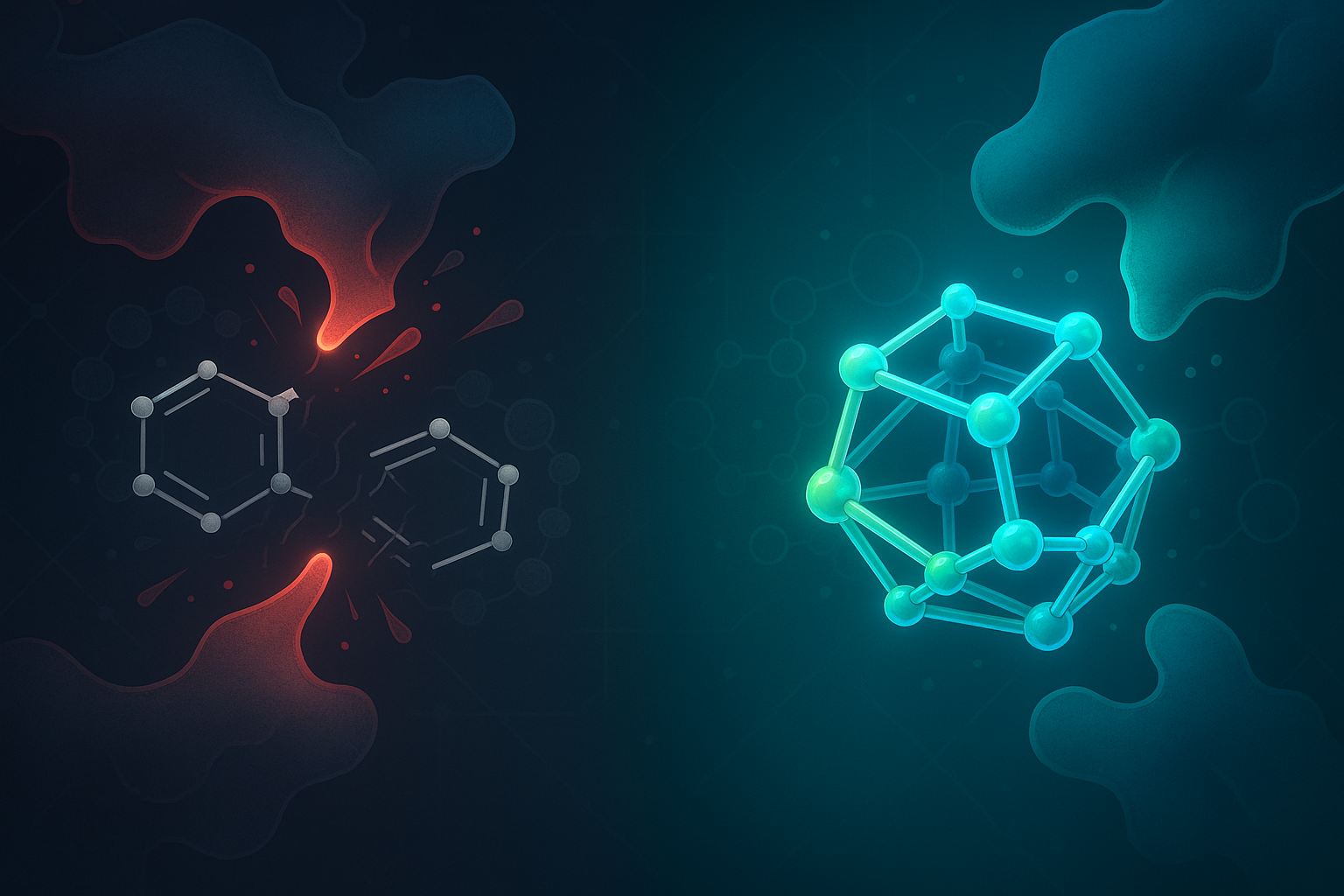
The research team, led by Aidan Kerckhoffs and colleagues, tackled this challenge by creating three-dimensional molecular alternatives called BCHeps. If naphthalene compounds are like flat pancakes, BCHeps are like sturdy geometric cages. This 3D structure makes them much harder for destructive enzymes to attack, similar to how a soccer ball is more difficult to tear apart than a piece of paper.
The breakthrough lies in creating true bioisosteres, which are essentially molecular body doubles. These BCHep compounds can step in and perform the same job as their flat counterparts while being much more resistant to metabolic breakdown. It's like replacing a fragile glass component in a machine with a durable plastic one that performs the exact same function.
The team's synthetic approach represents a major advance in organic chemistry methodology. They developed practical pathways to build these complex 3D structures in ways that pharmaceutical companies can actually use. This wasn't just about proving a concept; it was about creating a toolbox that drug developers can immediately put to work.
The validation process was equally impressive. The researchers systematically demonstrated that their BCHep compounds could truly replace naphthalene structures without losing therapeutic effectiveness. They showed reduced susceptibility to the problematic cytochrome P450 enzymes while maintaining the molecular properties needed for drug action.
This research addresses one of the pharmaceutical industry's most persistent challenges: drug-induced toxicity from metabolic processes. Many promising medications never make it to patients because their flat molecular structures lead to dangerous breakdown products. Others reach the market but carry significant side effect risks.
The implications extend far beyond this single study. By providing a general strategy for replacing problematic flat structures with 3D alternatives, this work opens new possibilities across numerous therapeutic areas. Existing drugs could potentially be redesigned to be safer, while new drug discoveries won't be limited by the traditional constraints of flat molecular architecture.
Perhaps most importantly, this represents a fundamental shift in how we think about drug design. Instead of accepting the limitations of flat structures, medicinal chemists now have a proven pathway to three-dimensional alternatives that maintain efficacy while potentially eliminating major sources of toxicity. It's a reminder that sometimes the best solution isn't to fix a problem, but to engineer around it entirely.
Real-World Impact
Quick Takeaways
- Could lead to safer versions of existing medications by replacing toxic flat molecular structures
- Opens new possibilities for drug discovery by removing traditional constraints of flat architecture
- May reduce drug-related side effects and toxicity across multiple therapeutic areas
- Provides pharmaceutical companies with practical tools for developing 3D molecular alternatives
- Could impact treatments for various diseases where naphthalene-containing drugs are currently used
The development of BCHep bioisosteres represents a paradigm shift that could fundamentally change pharmaceutical development across multiple therapeutic areas. By providing a practical solution to replace toxic naphthalene structures while maintaining drug efficacy, this research opens the door to redesigning existing medications that currently carry significant side effect burdens. Patients taking drugs for cardiovascular disease, neurological conditions, and other areas where naphthalene-based compounds are prevalent could potentially benefit from safer alternatives with reduced metabolic toxicity.
From an industry perspective, this breakthrough removes a major constraint that has limited drug discovery efforts for decades. Pharmaceutical companies often abandon promising drug candidates because their flat molecular structures lead to unacceptable toxicity profiles. With validated 3D alternatives now available, these previously unusable compounds could be resurrected and developed into safe, effective treatments. The methodology also enables entirely new approaches to drug design, where three-dimensional thinking replaces the traditional focus on flat molecular architectures.
The broader implications extend to healthcare economics and patient outcomes. Drugs with improved safety profiles typically require less monitoring, cause fewer hospitalizations due to adverse effects, and have better patient compliance rates. This could translate into reduced healthcare costs and improved quality of life for millions of patients worldwide, while also enabling pharmaceutical companies to develop more successful and widely-adopted medications.
For Researchers & Scientists - Technical Section
Kerckhoffs and colleagues employed advanced synthetic organic chemistry techniques to develop aryl-fused bicyclo[3.1.1]heptane scaffolds as three-dimensional bioisosteres for naphthalene moieties. Their methodology involved systematic structural modification and validation studies to demonstrate reduced cytochrome P450-mediated metabolism while maintaining pharmacologically relevant molecular properties. The research combined computational modeling, synthetic chemistry, and biological validation to establish practical synthetic pathways that enable pharmaceutical applications of these novel 3D molecular frameworks.
Methodology & Approach
Methodology & Approach
The research team employed a multi-faceted approach combining computational chemistry, synthetic organic methodology, and biological validation. They systematically designed aryl-fused bicyclo[3.1.1]heptane scaffolds using structure-based design principles, then developed practical synthetic routes to access these three-dimensional structures. The methodology included extensive characterization of the molecular properties required for effective bioisosterism, ensuring that the 3D alternatives could truly replace flat naphthalene structures without compromising drug function.
Critical to their success was the development of derivatizable synthetic pathways that make these compounds accessible for pharmaceutical applications. The team validated their approach through systematic comparison studies, demonstrating reduced susceptibility to cytochrome P450-mediated metabolism while maintaining the molecular recognition properties necessary for therapeutic activity. This comprehensive validation process established these BCHep compounds as genuine bioisosteres rather than mere structural analogs.
Key Techniques & Methods
- Bicyclic scaffold synthesis: Advanced organic chemistry methods to construct three-dimensional molecular frameworks
- Bioisosteric design: Systematic replacement of flat molecular structures with 3D alternatives that maintain function
- Cytochrome P450 metabolic studies: Evaluation of how liver enzymes process the new molecular structures
- Structure-activity relationship analysis: Determining which molecular features are essential for drug activity
- Synthetic methodology development: Creating practical laboratory procedures for pharmaceutical applications
- Computational molecular modeling: Using computer simulations to predict and optimize molecular properties
Key Findings & Results
- Successfully synthesized aryl-fused bicyclo[3.1.1]heptanes as functional 3D replacements for naphthalene structures
- Demonstrated significantly reduced susceptibility to cytochrome P450-mediated metabolic breakdown
- Validated that BCHep compounds can serve as true bioisosteres maintaining therapeutic effectiveness
- Established practical synthetic pathways suitable for pharmaceutical industry applications
- Confirmed that 3D molecular architecture provides protection against enzymatic degradation
- Developed derivatizable compounds that maintain drug-like molecular properties while improving safety profiles
Conclusions
The successful development of aryl-fused bicyclo[3.1.1]heptanes as naphthalene bioisosteres represents a significant advancement in medicinal chemistry, providing a validated strategy for replacing problematic flat molecular structures with three-dimensional alternatives. The reduced metabolic liability combined with maintained pharmacological properties demonstrates the potential for creating safer drug molecules across multiple therapeutic areas. This work establishes both the synthetic methodology and validation framework necessary for pharmaceutical implementation, suggesting broad applicability for improving drug safety profiles while preserving therapeutic efficacy.
-- readers