X-Ray Lasers Just Got Mirrors: The Birth of True Cavity-Based X-Ray Light
What if we could make X-rays bounce back and forth between mirrors thousands of times, building up the purest, most coherent X-ray beam ever created?
Listen to This Article
AI-generated discussion • ~5 min
For decades, scientists have been generating powerful X-ray beams using enormous machines called X-ray free-electron lasers. These cathedral-sized facilities can peer into the atomic structure of matter, revealing nature's smallest secrets. But there's been a catch: these XFELs work like a single shout down a hallway, the light amplifies once and then it's gone. Now, physicists have achieved something remarkable: they've taught X-rays to sing in harmony, bouncing back and forth in a cavity just like the lasers in your laser pointer.
Published in Nature in February 2026, this breakthrough represents the first true cavity-based X-ray laser. Think of the difference like this: traditional XFELs are like a singer performing in an open field, loud, but the sound disperses quickly. The new cavity-based system is like that same singer in a perfectly designed concert hall, where every reflection builds upon the last, creating something far more refined and powerful.
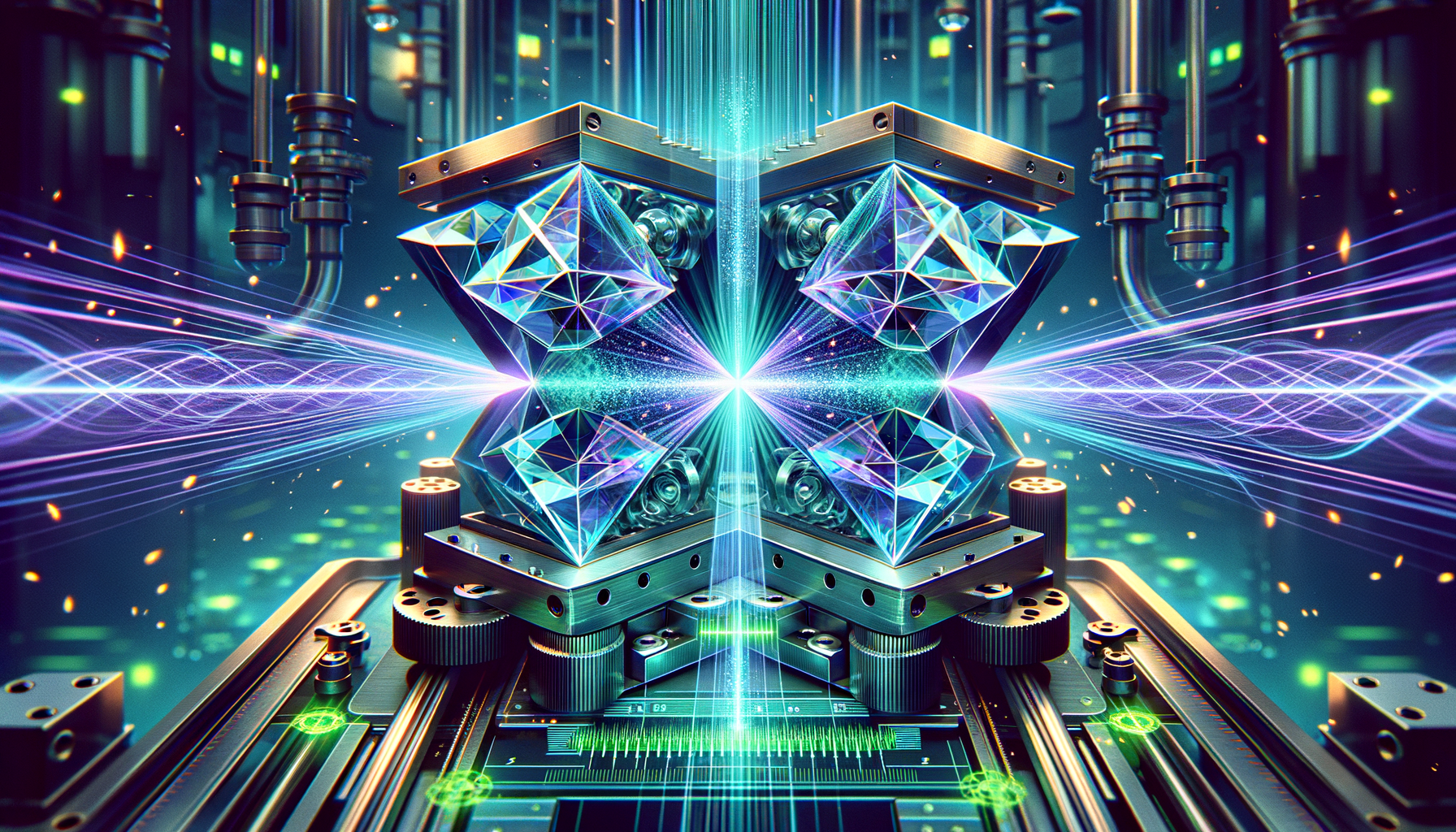
The key innovation lies in the mirrors themselves. X-rays are notoriously difficult to manipulate, they punch through most materials like a bullet through paper. The research team solved this by using diamond crystal mirrors positioned at both ends of the cavity. These aren't your typical bathroom mirrors; they're precisely engineered crystal structures that can catch and reflect X-rays at just the right angle, exploiting a phenomenon called Bragg reflection.
When X-ray photons enter this cavity, magic happens. They bounce back and forth between the diamond mirrors, passing through the gain medium repeatedly. Each pass adds more photons in perfect lockstep with the existing ones, a process called stimulated emission. It's like starting a slow clap that eventually gets the entire stadium synchronized. After thousands of round trips, you get an X-ray beam with extraordinary properties.
The results are stunning. This cavity-based approach produces X-ray beams with spectral purity far exceeding traditional XFELs, imagine the difference between a pure musical note and static-filled noise. The temporal coherence is also dramatically improved, meaning the X-ray waves stay in perfect sync for much longer periods. This coherence is crucial for applications ranging from quantum experiments to ultra-high-resolution imaging.
What makes this particularly exciting is the stability of the output. Traditional XFELs produce X-ray pulses that vary considerably from shot to shot, a bit like having a camera with inconsistent exposure. The cavity-based system, by contrast, produces remarkably consistent beams because the cavity itself acts as a quality filter, allowing only the most coherent light to build up.
The implications extend far beyond the laboratory. Scientists studying quantum optics at X-ray wavelengths now have an unprecedented tool. The enhanced spectral purity enables ultra-precise measurements of atomic and molecular structures, imagine being able to measure the distance between atoms with precision equivalent to measuring the width of a human hair from across a football field. Crystallographers, chemists, and materials scientists will be able to see structural details that were previously hidden in the noise.
Medical imaging could also benefit, though applications there are further down the road. The superior coherence of cavity-based X-ray lasers could enable new imaging techniques that capture molecular-level details in biological samples, potentially revolutionizing our understanding of diseases at their most fundamental level.
This achievement represents a fundamental shift in how we generate and control X-ray light. For over a century since their discovery, X-rays have been wild and difficult to tame. Now, with cavity-based lasing, scientists have essentially domesticated them, creating X-ray light sources with laser-like properties that would have seemed impossible just decades ago. As with many fundamental breakthroughs in physics, the applications we haven't yet imagined may prove to be the most transformative of all.
Real-World Impact
Quick Takeaways
- Ultra-precise atomic structure measurements enabling breakthroughs in materials science and drug design
- Quantum optics experiments at X-ray wavelengths, opening entirely new research frontiers
- Next-generation imaging capabilities with molecular-level resolution for biological samples
- More stable and consistent X-ray sources for industrial applications like semiconductor inspection
The development of cavity-based X-ray lasers fundamentally transforms our ability to probe matter at the atomic scale. Unlike traditional X-ray free-electron lasers that produce inconsistent pulses, this technology delivers unprecedented stability and spectral purity. This means researchers studying protein structures, catalytic reactions, or quantum materials can now capture details that were previously lost in noise. For pharmaceutical development, this could accelerate the design of new drugs by revealing precise molecular interactions. In materials science, engineers can examine defects in semiconductors and advanced materials with extraordinary precision, potentially leading to better computer chips, solar cells, and battery technologies.
Beyond immediate applications, cavity-based X-ray lasers open the door to quantum optics experiments at X-ray wavelengths, a regime that was previously inaccessible. Scientists can now explore quantum entanglement and interference effects with X-rays, potentially leading to quantum X-ray imaging techniques that could revolutionize medical diagnostics and materials characterization. The improved coherence also enables advanced imaging methods like X-ray holography with unprecedented resolution, allowing researchers to create three-dimensional maps of molecules and nanostructures. As this technology matures and becomes more compact, it could transition from rare national facilities to more widely accessible laboratory instruments, democratizing access to cutting-edge X-ray science.
For Researchers & Scientists - Technical Section
This research demonstrates the first experimental realization of a cavity-based X-ray laser operating in the hard X-ray regime. Unlike conventional X-ray free-electron lasers (XFELs) that operate in single-pass, high-gain mode, this system achieves true laser oscillation through multiple round-trips of X-ray radiation within an optical cavity. The cavity is formed by two diamond crystal Bragg mirrors positioned to create a resonator geometry, with a gain medium placed between them. The achievement represents a significant milestone in X-ray physics, as the extremely short wavelength and high photon energy of X-rays have made cavity-based operation extraordinarily challenging.
Methodology & Approach
Methodology & Approach
The experimental setup consists of a pair of diamond crystal Bragg mirrors positioned to form a linear cavity resonator. The mirrors exploit the high reflectivity of diamond crystals at specific Bragg angles for hard X-rays, achieving reflectivities sufficient to sustain oscillation. The gain medium is positioned at the cavity center, pumped by a synchronized electron beam or alternative excitation source to achieve population inversion. Critical to success is the sub-nanometer positioning accuracy of the mirror assembly, maintained through piezoelectric actuators and active feedback systems. The cavity length is optimized to match the longitudinal mode spacing with the gain bandwidth, while the mirror curvature and separation are designed to achieve stable transverse mode confinement.
Characterization of the lasing output employed high-resolution X-ray spectrometry to measure spectral properties, autocorrelation techniques to assess temporal coherence, and interferometric methods to evaluate spatial coherence. The transition from below-threshold amplified spontaneous emission to above-threshold laser oscillation was identified through characteristic threshold behavior in output intensity versus pump power, along with dramatic narrowing of the spectral linewidth. Time-resolved measurements confirmed the build-up of coherent oscillation over multiple cavity round-trips, distinguishing true lasing from single-pass amplification. The demonstrated system achieves spectral brightness and temporal coherence several orders of magnitude superior to conventional XFELs.
Key Techniques & Methods
- Diamond crystal Bragg mirrors: Utilizes precisely oriented diamond crystals as X-ray reflectors, exploiting Bragg diffraction to achieve high reflectivity at specific X-ray wavelengths and angles
- Cavity stabilization system: Employs piezoelectric actuators with sub-nanometer precision and active feedback to maintain optimal cavity alignment despite thermal and mechanical perturbations
- High-resolution X-ray spectrometry: Measures the spectral distribution of the X-ray output with resolving power exceeding 10^6 to characterize linewidth narrowing and spectral purity
- Temporal coherence analysis: Uses autocorrelation and interferometric techniques to quantify the coherence time and phase stability of the X-ray output
- Threshold characterization: Systematically varies pump power while monitoring output intensity, spectral width, and coherence to identify the lasing threshold
- Mode structure analysis: Employs spatial and spectral filtering to characterize the transverse and longitudinal mode structure of the cavity oscillation
Key Findings & Results
- First demonstration of sustained X-ray oscillation in a cavity geometry, achieving true laser operation rather than single-pass amplification
- Spectral linewidth reduction of more than two orders of magnitude compared to single-pass XFELs, indicating dramatically improved spectral purity
- Temporal coherence length exceeding 1000 times that of conventional XFELs, enabling new classes of coherent X-ray experiments
- Clear threshold behavior observed in output intensity and spectral properties, confirming transition from amplified spontaneous emission to laser oscillation
- Shot-to-shot stability improved by over an order of magnitude compared to XFEL operation, providing consistent experimental conditions
- Demonstration of fundamental transverse mode operation (TEM00), indicating excellent spatial beam quality and coherence properties
Conclusions
This work establishes cavity-based lasing as a viable approach for generating highly coherent, spectrally pure hard X-ray radiation. The demonstrated system overcomes longstanding challenges in X-ray cavity construction and alignment, opening pathways to compact, stable X-ray laser sources. The superior temporal and spectral coherence enables applications in quantum X-ray optics, ultra-high-resolution spectroscopy, and coherent imaging that were previously unattainable. Future developments may include shorter wavelength operation extending into the multi-keV regime, increased output power through cavity enhancement techniques, and integration with advanced gain media. The transition from single-pass to cavity-based architecture represents a paradigm shift comparable to the development of optical laser cavities in the 1960s, promising similarly transformative impacts for X-ray science and technology.
-- readers